Understanding bacterial transcription
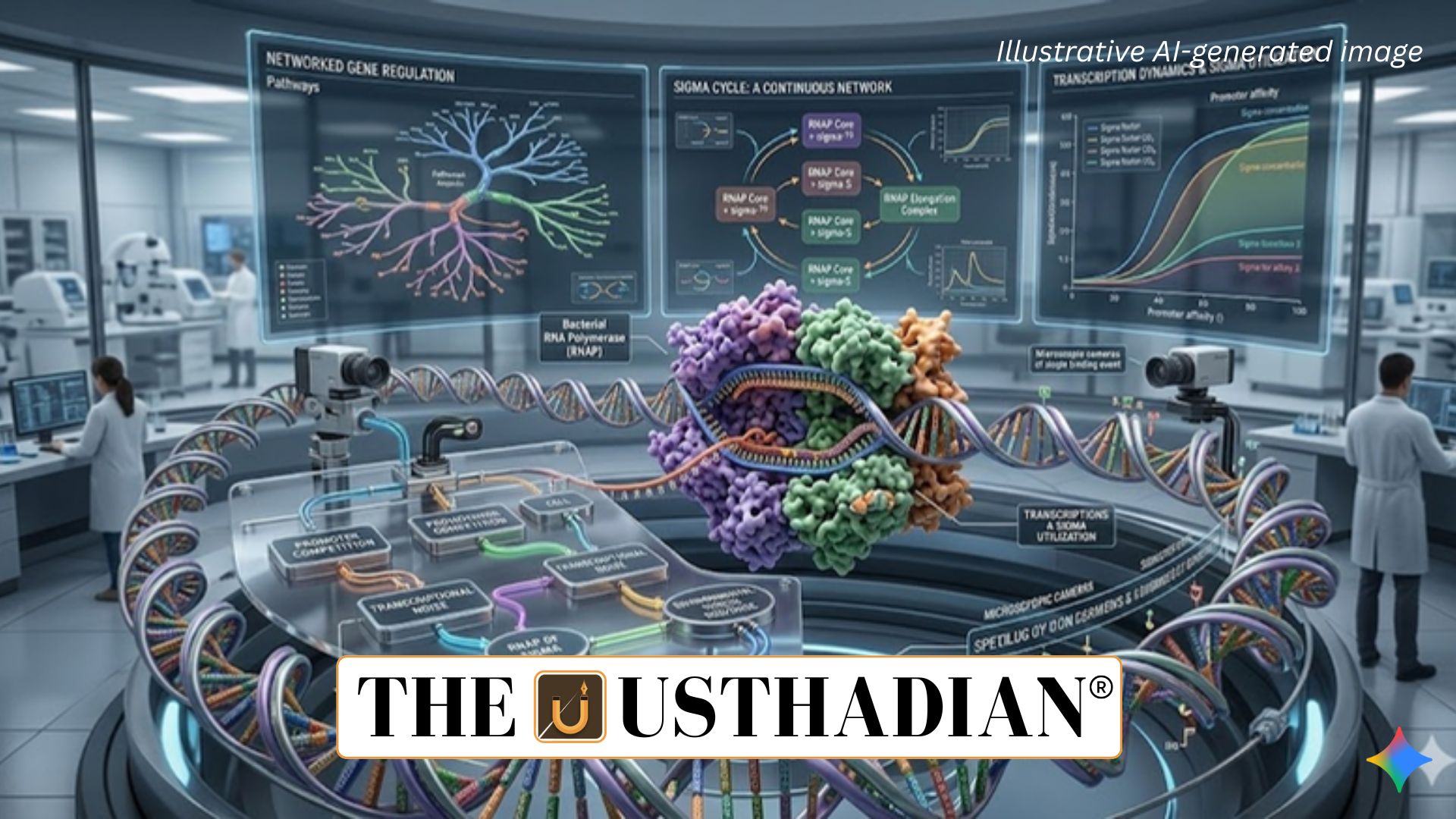
Rethinking the Sigma Cycle in Bacterial Gene Regulation: Bacterial cells regulate gene activity through a process called transcription, where genetic information stored in DNA is copied into RNA. This process is controlled by specialized proteins known as sigma factors, which guide RNA polymerase to specific gene regions called promoters.
In traditional molecular biology models, sigma factors temporarily attach to RNA polymerase to begin transcription and later detach to allow the enzyme to continue copying DNA into RNA.
Static GK fact: The central dogma of molecular biology describes the flow of genetic information as DNA → RNA → Protein, a concept proposed by Francis Crick in 1958.
The classical sigma cycle theory
For decades, scientists accepted the concept of the sigma (σ) cycle as the universal mechanism controlling bacterial gene activation. According to this model, sigma factors bind to RNA polymerase, helping the enzyme recognize the correct starting point on DNA.
Once transcription begins, the sigma factor was believed to detach, allowing RNA polymerase to move along the DNA strand and synthesize RNA efficiently. The detached sigma factor could then attach to another RNA polymerase molecule, continuing the cycle.
This concept became a foundational principle in microbiology and was widely taught in textbooks.
Role of Escherichia coli in the model
Much of the evidence supporting the sigma cycle came from research on Escherichia coli, one of the most studied bacteria in the world. Scientists particularly focused on the σ70 sigma factor, which controls the transcription of most essential genes in this organism.
Experiments with E. coli σ70 suggested that sigma factors detach shortly after transcription begins. This observation led researchers to generalize the mechanism across many bacterial species.
Static GK Tip: Escherichia coli is a Gram-negative bacterium commonly found in the human intestine and widely used as a model organism in genetics and biotechnology.
New research challenges the traditional model
Recent scientific research has questioned the universality of the sigma cycle. Advanced molecular techniques indicate that sigma factors may remain associated with RNA polymerase for longer periods during transcription than previously believed.
This finding suggests that the transcription process may be more complex than the classical cycle model proposed earlier. Instead of repeatedly detaching and reattaching, sigma factors may participate in additional regulatory roles while transcription continues.
Such discoveries indicate that bacterial gene regulation mechanisms may vary across species and conditions.
Implications for bacterial evolution
The revision of the sigma cycle model provides important insights into the evolution of bacterial gene regulation. If sigma factors behave differently across organisms, it implies that bacteria have developed diverse strategies to control gene expression.
Understanding these mechanisms could improve research in microbiology, biotechnology, and antibiotic development. Since gene regulation determines how bacteria respond to environmental stress, new knowledge in this field may help scientists design better antimicrobial strategies.
Static GK fact: The enzyme RNA polymerase is responsible for synthesizing RNA molecules from DNA templates in both prokaryotic and eukaryotic cells, although their structures differ.
Static Usthadian Current Affairs Table
Rethinking the Sigma Cycle in Bacterial Gene Regulation:
| Topic | Detail |
| Scientific concept | Sigma (σ) cycle in bacterial transcription |
| Key proteins involved | Sigma factors and RNA polymerase |
| Traditional understanding | Sigma factors detach after transcription begins |
| Model organism used | Escherichia coli |
| Important sigma factor | σ70 controlling essential gene transcription |
| New scientific finding | Sigma factors may remain associated longer with RNA polymerase |
| Research significance | Revises long-standing model of bacterial gene regulation |
| Scientific field | Molecular biology and microbiology |
| Broader importance | Helps understand bacterial evolution and gene expression |