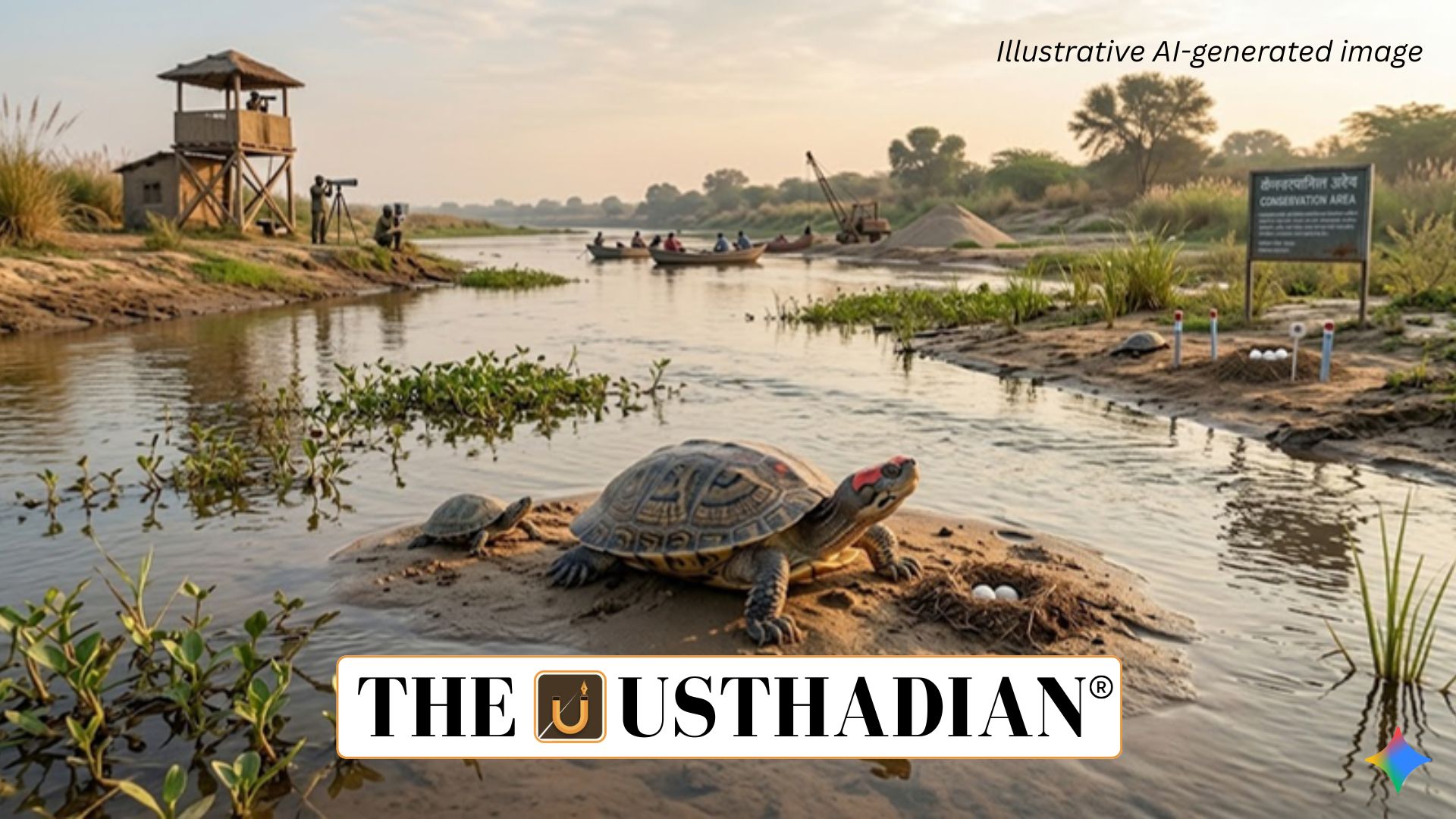
Species overview and distribution
Red Crowned Roofed Turtle Conservation Status: The Red Crowned Roofed Turtle (Batagur kachuga) is a large freshwater turtle species historically distributed across India, Nepal, and Bangladesh. Over time, its range has drastically reduced due to human pressures.
At present, the species is confined mainly to the Ganga River basin, with a stronghold in the Chambal River basin, which provides relatively cleaner and protected habitats.
Static GK fact: The Chambal River flows through Madhya Pradesh, Rajasthan, and Uttar Pradesh, and is known for its rich biodiversity including gharials and river dolphins.
Conservation status and legal protection
The turtle is listed as Critically Endangered on the IUCN Red List, indicating an extremely high risk of extinction in the wild. Its population has sharply declined due to overexploitation and habitat degradation.
Under India’s Wildlife (Protection) Act, 1972, it is placed in Schedule I, offering the highest level of legal protection. It is also included in CITES Appendix I, restricting international trade.
Static GK Tip: Schedule I species receive the same level of protection as tigers and elephants in India.
Key biological features
The species shows clear sexual dimorphism, where females are significantly larger than males. This size difference plays a role in reproduction and nesting behavior.
During the breeding season, male turtles develop striking coloration on their heads and necks, displaying bright red, yellow, and blue hues. This unique feature makes them visually distinctive among freshwater turtles.
Threats and population decline
The primary threat to the species has been intensive hunting of adults and eggs, which has severely impacted population numbers. Eggs are often collected for consumption, while adults are hunted for meat.
Additionally, habitat loss, river pollution, sand mining, and dam construction have disrupted nesting sites and ecological balance. These factors collectively contribute to the species’ rapid decline.
Static GK fact: Riverine turtles depend on sandy riverbanks for nesting, making them highly vulnerable to sand mining activities.
Ecological significance
The Red Crowned Roofed Turtle plays a vital role as a bio-indicator of river health, reflecting the ecological condition of freshwater systems. Its presence indicates relatively clean and stable aquatic environments.
It also contributes to nutrient recycling by feeding on organic matter, thereby maintaining ecological balance within river ecosystems.
Conservation efforts and future outlook
Efforts are being made through protected areas like the National Chambal Sanctuary, which provides a safer habitat for the species. Conservation programs include captive breeding, habitat restoration, and awareness campaigns.
However, long-term survival depends on strict enforcement of laws, reduction in river pollution, and community participation in conservation initiatives.
Static Usthadian Current Affairs Table
Red Crowned Roofed Turtle Conservation Status:
| Topic | Detail |
| Scientific Name | Batagur kachuga |
| Distribution | Ganga River basin, mainly Chambal River |
| Conservation Status | Critically Endangered (IUCN) |
| Legal Protection | Schedule I of Wildlife Protection Act, 1972 |
| International Status | CITES Appendix I |
| Key Feature | Bright colored males during breeding season |
| Major Threat | Hunting of adults and eggs |
| Habitat Type | Freshwater riverine ecosystem |
| Ecological Role | Bio-indicator and nutrient recycler |
| Conservation Area | National Chambal Sanctuary |