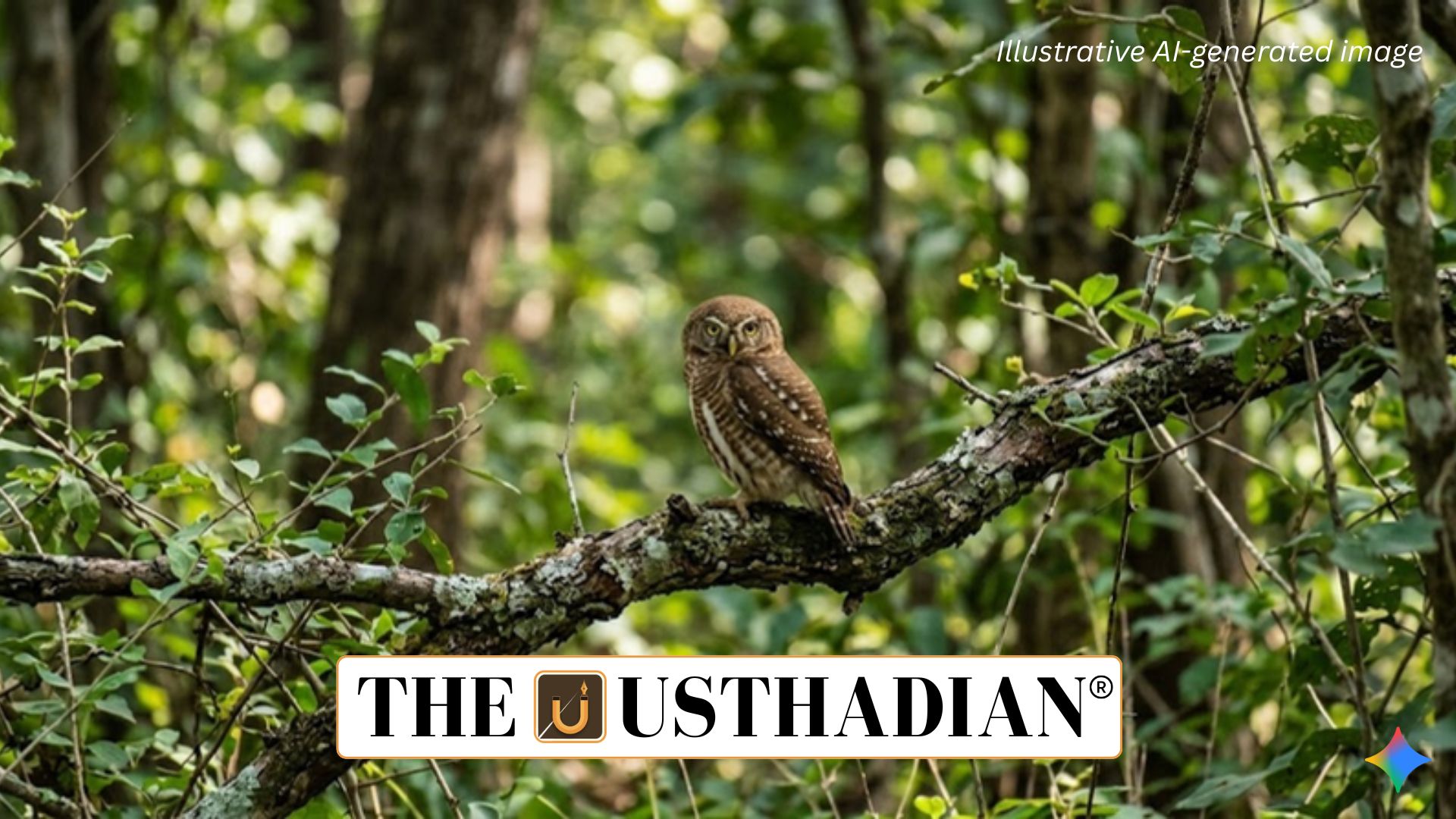
First Record of Forest Owlet in Kuno
Rare Forest Owlet Spotted in Kuno National Park: Kuno National Park in Madhya Pradesh recently recorded its first-ever sighting of the endangered Forest Owlet. The rare bird was spotted in the Parond Beat area by tourism operator Labh Yadav during a routine field observation.
The identification was later confirmed by wildlife expert Vivek Patel of the Wildlife Research and Conservation Society, Pune. Officials confirmed that this species had never been documented earlier within the park’s boundaries.
The discovery comes just days before the planned arrival of eight cheetahs from Botswana under Project Cheetah. Conservationists believe the finding highlights the improving ecological health of the region.
Static GK fact: Kuno National Park, located in Sheopur district of Madhya Pradesh, was earlier known as Kuno Wildlife Sanctuary before being upgraded to national park status in 2018.
Conservation Significance of the Discovery
The Forest Owlet (Athene blewitti) is among the rarest birds of prey in the world. According to the IUCN Red List, the species is classified as Endangered, with an estimated global adult population of only 250 to 999 individuals.
Historically, the species had a very restricted distribution in central India, mainly in parts of Madhya Pradesh, Maharashtra, and Gujarat. Within Madhya Pradesh, earlier records were limited to districts such as Khandwa, Burhanpur, and Betul.
The new sighting in Kuno National Park significantly expands the known geographical range of the species. Wildlife authorities have now announced detailed ecological surveys to determine whether a stable population exists in the region.
Static GK Tip: The IUCN Red List of Threatened Species is the world’s most comprehensive inventory for assessing the global conservation status of plants and animals.
Historical Background of the Forest Owlet
The Forest Owlet was first discovered in 1872 by Irish naturalist F. R. Blewitt in eastern Madhya Pradesh. However, after 1884, the species was not recorded for over a century.
Due to the absence of sightings, it was widely believed to be extinct. The species was dramatically rediscovered in 1997 in Nandurbar district of Maharashtra, generating significant excitement in the global ornithological community.
This rediscovery highlighted the importance of systematic biodiversity surveys and conservation programs in protecting rare species.
Habitat and Behaviour of the Species
Unlike most owl species that are nocturnal, the Forest Owlet is diurnal and remains active during daylight hours. It is most commonly observed between 6 a.m. and 10 a.m., often perched on tall trees even under strong sunlight.
The species prefers dry deciduous forests, particularly areas dominated by teak trees. These forests provide suitable nesting cavities and abundant prey such as insects, small mammals, and reptiles.
However, the bird faces serious threats due to deforestation, agricultural expansion, and habitat fragmentation in central India.
Link with Project Cheetah and Habitat Restoration
The discovery has drawn attention because it occurred during the ongoing Project Cheetah, India’s ambitious program to reintroduce African cheetahs into suitable habitats.
Forest officials believe that grassland restoration, prey management, and habitat improvement undertaken for cheetahs may have indirectly benefited several other species.
Improved habitat quality could be encouraging rare wildlife such as the Forest Owlet to expand into new areas like Kuno National Park.
This development highlights how large-scale conservation initiatives can produce positive ecosystem-wide impacts, supporting multiple species simultaneously.
Static Usthadian Current Affairs Table
Rare Forest Owlet Spotted in Kuno National Park:
| Topic | Detail |
| Species | Forest Owlet (Athene blewitti) |
| Conservation status | Endangered according to IUCN Red List |
| First discovery | 1872 by naturalist F. R. Blewitt |
| Rediscovery | 1997 in Nandurbar district, Maharashtra |
| New sighting location | Kuno National Park, Madhya Pradesh |
| Estimated global population | Around 250–999 adult individuals |
| Habitat | Dry deciduous forests dominated by teak |
| Major conservation program | Project Cheetah |
| Behaviour | One of the few diurnal owl species |
| Key conservation threat | Deforestation and habitat fragmentation |