Global approval of first carbon credits
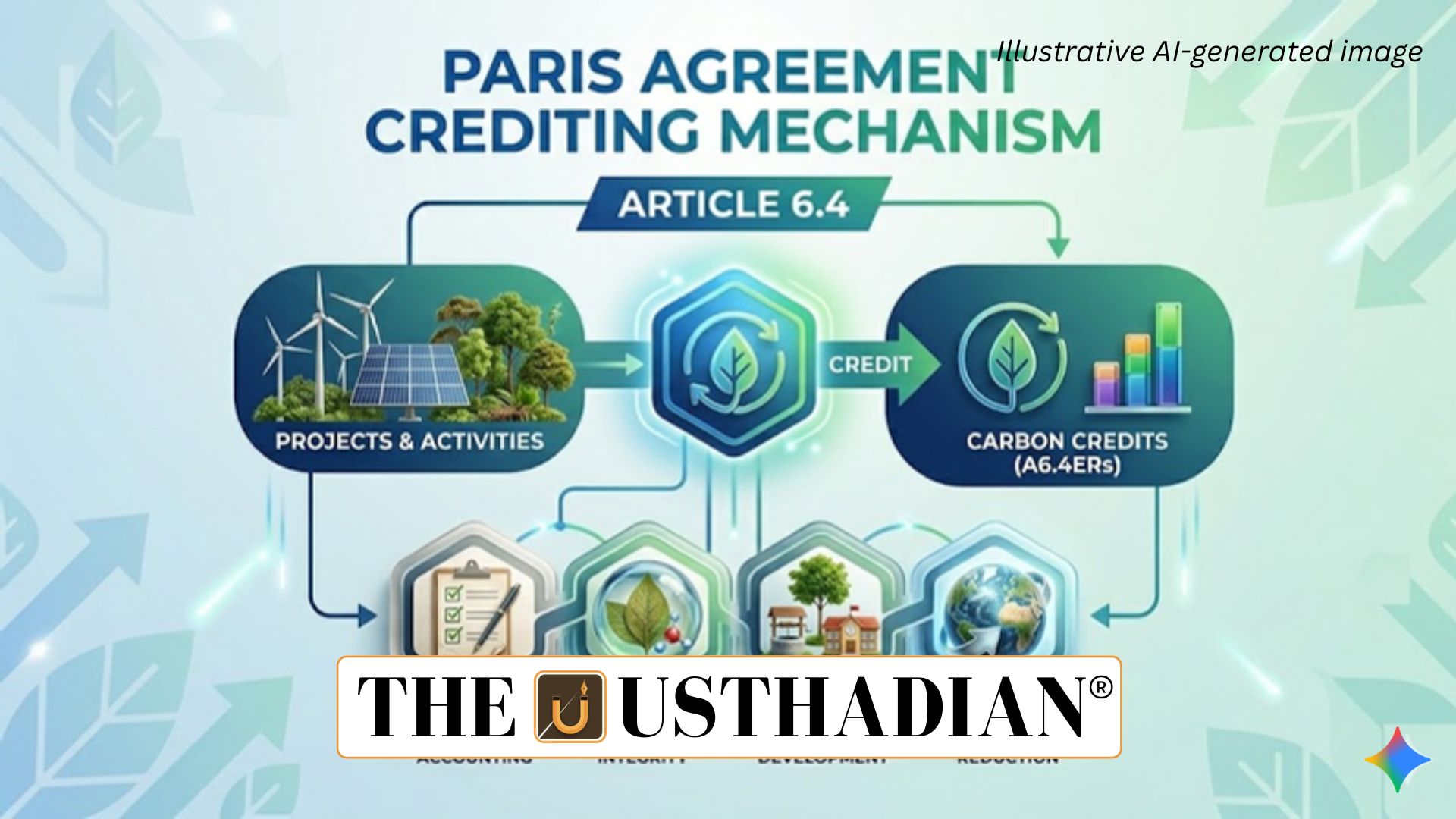
Paris Agreement Crediting Mechanism under Article 6.4: The United Nations recently announced the approval of the first carbon credits under the Paris Agreement Crediting Mechanism (Article 6.4). The initiative involves a climate project in Myanmar, coordinated with the Republic of Korea. This approval marks a significant step in operationalizing the global carbon market framework envisioned under the Paris Agreement.
The mechanism allows countries and companies to participate in international emission reduction activities. Through this system, verified emission reductions can be converted into carbon credits that can be traded globally.
Understanding the Article 6.4 mechanism
The Article 6.4 mechanism is a structured international carbon crediting system created under the Paris Agreement. Its main objective is to encourage measurable and verifiable reductions in greenhouse gas emissions while supporting sustainable development in participating countries.
Under this framework, emission reduction projects are registered and monitored by international bodies. Once the emission reductions are verified, carbon credits are issued which can be sold or transferred between entities.
This system promotes climate cooperation by allowing investments in emission reduction projects across borders. It also supports developing countries by attracting climate finance and green technology.
Static GK fact: The Paris Agreement was adopted in 2015 during COP21 in Paris, aiming to limit global temperature rise to well below 2°C above pre-industrial levels.
How international carbon trading works
The Article 6.4 mechanism allows companies or governments in one country to finance emission reduction projects in another country. The resulting emission reductions are converted into carbon credits, which can then be used or sold.
For example, a company based in Republic of Korea may invest in a renewable energy project in Myanmar. If the project reduces greenhouse gas emissions, those reductions are certified and issued as credits.
These credits can then be used by the company to offset its own emissions or sold to other companies participating in the carbon market. This creates a global trading system for emission reductions.
Components of Article 6 framework
The Paris Agreement’s Article 6 provides a broader framework for international climate cooperation. It contains three major components that guide how countries collaborate to reduce emissions.
Article 6.2 focuses on accounting and reporting guidance for countries participating in international carbon trading. It ensures transparency and prevents double counting of emission reductions.
Article 6.4 establishes a centralized carbon crediting mechanism supervised by international authorities. This system enables the generation and trading of verified carbon credits.
Article 6.8 promotes non-market-based cooperation, such as technology sharing, policy coordination, and capacity building among countries.
Static GK Tip: Carbon credits represent the reduction or removal of one metric tonne of carbon dioxide (CO₂) or equivalent greenhouse gases.
Importance for global climate action
The operationalization of Article 6.4 strengthens the global framework for achieving Nationally Determined Contributions (NDCs) under the Paris Agreement. It provides financial incentives for emission reduction activities across borders.
For developing countries, the mechanism can bring investments in renewable energy, energy efficiency, and sustainable infrastructure. At the same time, developed countries gain flexibility in meeting their climate targets.
As more projects receive approval, the international carbon market is expected to expand, supporting global efforts to combat climate change and greenhouse gas emissions.
Static Usthadian Current Affairs Table
Paris Agreement Crediting Mechanism under Article 6.4:
| Topic | Detail |
| Agreement | Paris Agreement |
| Mechanism | Article 6.4 Carbon Crediting Mechanism |
| Supervising Body | United Nations climate framework |
| Purpose | Generate and trade verified carbon credits |
| First approved project | Myanmar climate project coordinated with Republic of Korea |
| Key Objective | Encourage verifiable emission reductions |
| Article 6.2 | Accounting and reporting guidance for carbon trading |
| Article 6.4 | Global carbon crediting mechanism |
| Article 6.8 | Non-market based cooperation mechanisms |
| Carbon credit definition | Reduction of one metric tonne of CO₂ equivalent |