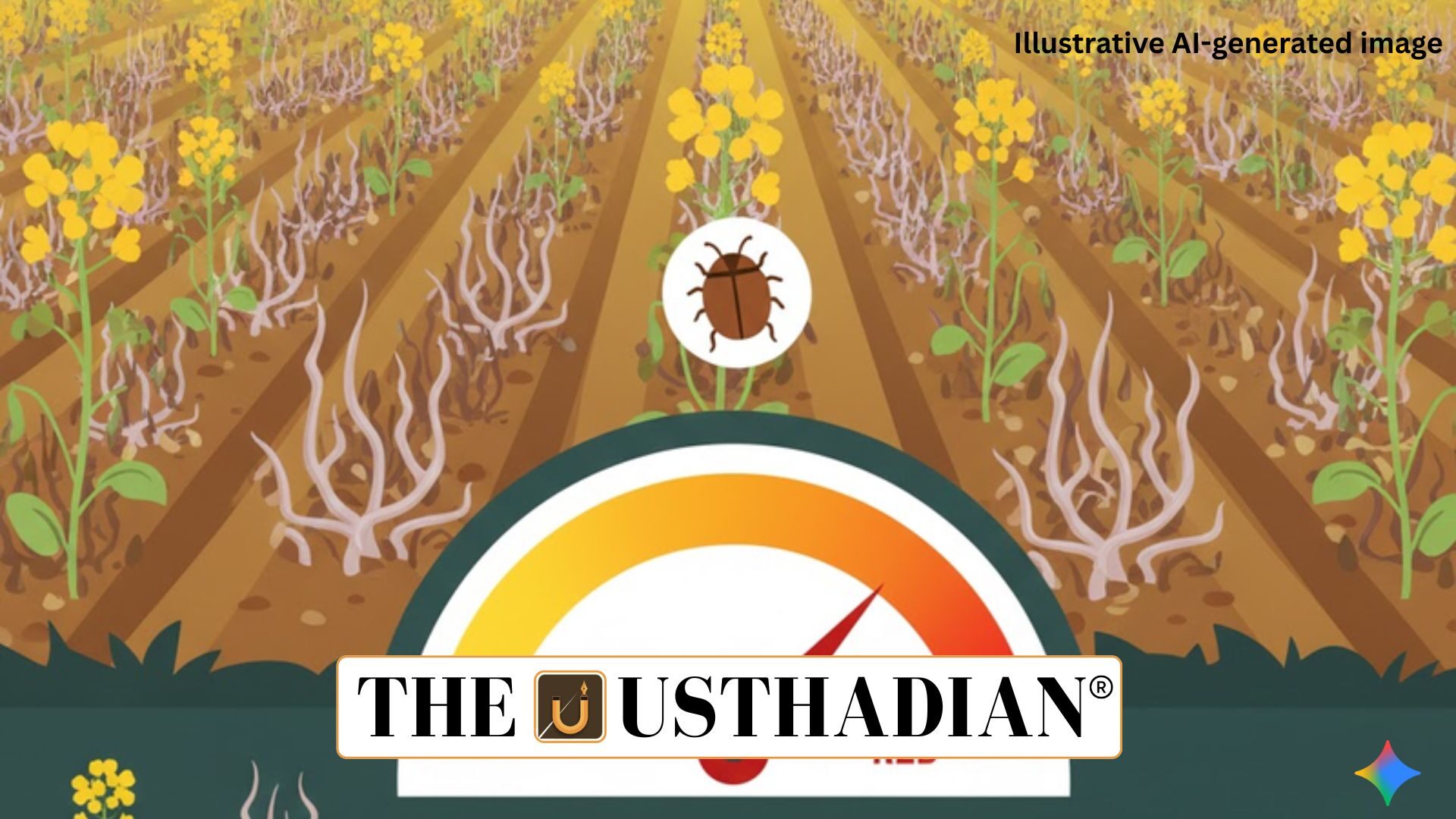
Emerging agricultural threat
Orobanche aegyptiaca and India’s Mustard Crisis: India’s mustard crop is facing a growing biological threat from Orobanche aegyptiaca, commonly known as Egyptian broomrape. This parasitic weed has become a serious concern in major mustard-growing belts, particularly in north-western India.
The weed is non-photosynthetic and lacks chlorophyll. It survives entirely by attaching itself to host plant roots and extracting nutrients, carbon, and water, weakening the crop system from below the soil surface.
Biological nature of Orobanche aegyptiaca
Orobanche aegyptiaca is a root-parasitic angiosperm. It remains underground during early growth and becomes visible only after serious damage is already done to the host plant.
The parasite forms specialized structures called haustoria, which penetrate mustard roots. Through this connection, it continuously siphons essential metabolites, leading to slow physiological collapse of the host plant.
Static GK fact: Parasitic plants like Orobanche belong to a group of holoparasites, meaning they depend fully on host plants for survival and energy.
Impact on mustard productivity
Mustard plants affected by Egyptian broomrape show wilting, yellowing, stunted growth, and weak flowering. These symptoms directly reduce pod formation and seed weight, leading to sharp yield losses.
In heavily infested fields, crop loss can reach 30–70%, making cultivation economically unsustainable for small farmers. The underground nature of infestation makes early detection extremely difficult.
The weed also produces thousands of microscopic seeds, which remain viable in soil for many years. This creates long-term soil contamination, making future cropping cycles vulnerable.
Importance of mustard in India
Mustard is India’s largest edible oil-yielding crop and forms the backbone of domestic edible oil security. It is generally sown from mid- to late-October under rabi cropping systems.
Rajasthan is the largest mustard-producing state, followed by Madhya Pradesh, Haryana, and Uttar Pradesh. The crop supports millions of farmers and contributes significantly to rural income.
Static GK Tip: Mustard belongs to the Brassicaceae family, the same family as cabbage, cauliflower, and radish.
Multiple biological stresses
Apart from Orobanche aegyptiaca, mustard is already vulnerable to aphid infestations, which reduce plant vigour and transmit viral diseases.
The crop also faces fungal diseases such as white rust, leaf blight, stem rot, and powdery mildew, creating a multi-stress environment for farmers and increasing dependence on chemical inputs.
This combination of parasitic weeds, pests, and pathogens weakens India’s oilseed self-sufficiency strategy.
Agricultural and policy relevance
The spread of Egyptian broomrape threatens oilseed productivity, farmer incomes, and edible oil availability. It also increases cultivation costs due to control measures and crop loss risks.
Integrated weed management, crop rotation, resistant varieties, and soil health restoration are becoming essential components of future mustard policy planning.
Static GK fact: Oilseeds are a strategic crop category in India’s food security planning due to their role in nutrition, trade balance, and farmer livelihoods.
Static Usthadian Current Affairs Table
Orobanche aegyptiaca and India’s Mustard Crisis:
| Topic | Detail |
| Orobanche aegyptiaca | Root-parasitic weed affecting mustard crops |
| Common name | Egyptian broomrape |
| Biological nature | Non-photosynthetic holoparasitic plant |
| Mode of damage | Extracts nutrients, water, and carbon from host roots |
| Crop affected | Mustard |
| Symptoms | Wilting, yellowing, stunted growth |
| Mustard sowing period | Mid- to late-October |
| Largest producer state | Rajasthan |
| Other crop threats | Aphids, white rust, leaf blight, stem rot, powdery mildew |
| Agricultural impact | Yield loss, soil contamination, economic stress |