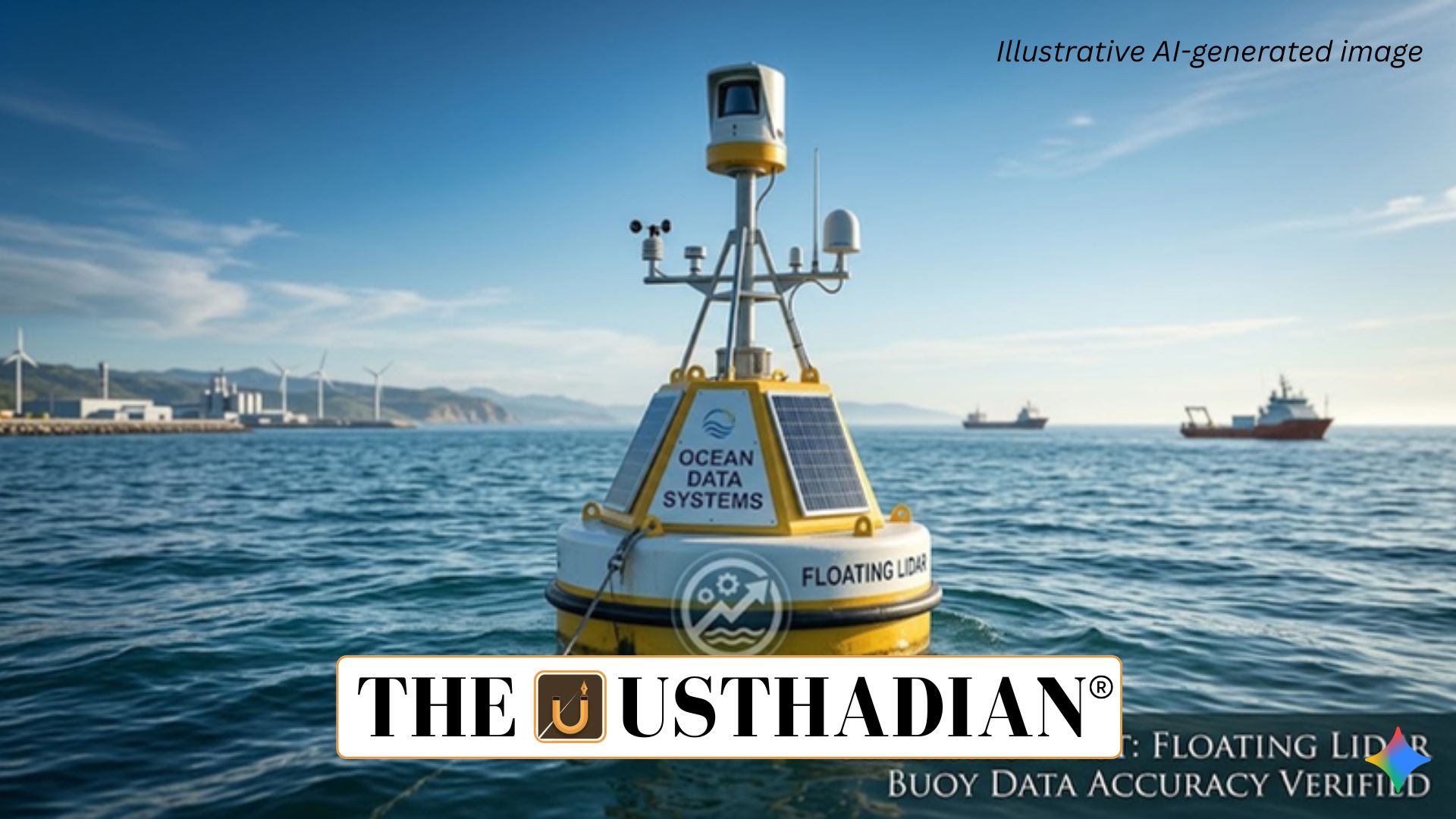
Breakthrough test off Tamil Nadu coast
NIOT Floating LiDAR Buoy Test Success: The National Institute of Ocean Technology (NIOT) successfully tested an indigenous Floating LiDAR Buoy System near the Muttom coast in Tamil Nadu. This marks a significant step in India’s push toward advanced ocean-based technologies.
The buoy is designed to operate in harsh marine conditions and collect accurate atmospheric data. It supports India’s growing interest in offshore wind energy development.
Static GK fact: NIOT operates under the Ministry of Earth Sciences, headquartered in Chennai.
Understanding LiDAR technology
The system uses Light Detection and Ranging (LiDAR) technology to measure wind speed, direction, and atmospheric parameters over the sea. It works by emitting laser pulses and analyzing their reflection from particles in the air.
This enables high-resolution vertical profiling of wind patterns, which is essential for offshore wind energy projects. The technology is more precise compared to traditional methods like meteorological masts.
Static GK Tip: LiDAR is widely used in fields like remote sensing, autonomous vehicles, and geospatial mapping.
Importance for offshore wind energy
India has significant potential for offshore wind energy, especially along the coasts of Tamil Nadu and Gujarat. The data collected from the LiDAR buoy will help identify suitable locations for wind farms.
Accurate wind assessment reduces risks and improves efficiency in energy production. This supports India’s commitment to renewable energy expansion and climate goals.
Static GK fact: India aims to achieve 500 GW of non-fossil fuel energy capacity by 2030.
Indigenous innovation and advantages
The buoy system is fully indigenously developed, reducing reliance on foreign technologies. It is cost-effective and adaptable to Indian marine conditions.
It can operate autonomously and transmit real-time data to onshore stations. This enhances continuous monitoring and long-term data collection capabilities.
Static GK Tip: Offshore wind farms generally produce more consistent energy compared to onshore wind farms due to steady sea winds.
Way forward
The successful test opens opportunities for large-scale deployment of such buoys across India’s coastline. It will strengthen marine research and support renewable energy planning.
With further advancements, India can emerge as a leader in ocean-based technological innovations. The integration of such systems will play a key role in sustainable development.
Static Usthadian Current Affairs Table
NIOT Floating LiDAR Buoy Test Success:
| Topic | Detail |
| Institution | National Institute of Ocean Technology |
| Location of Test | Muttom coast, Tamil Nadu |
| Technology Used | LiDAR |
| Purpose | Wind and meteorological data measurement |
| Ministry | Ministry of Earth Sciences |
| Key Benefit | Supports offshore wind energy |
| Nature | Indigenous system |
| Renewable Target | 500 GW by 2030 |