Nationwide survey for manuscript heritage
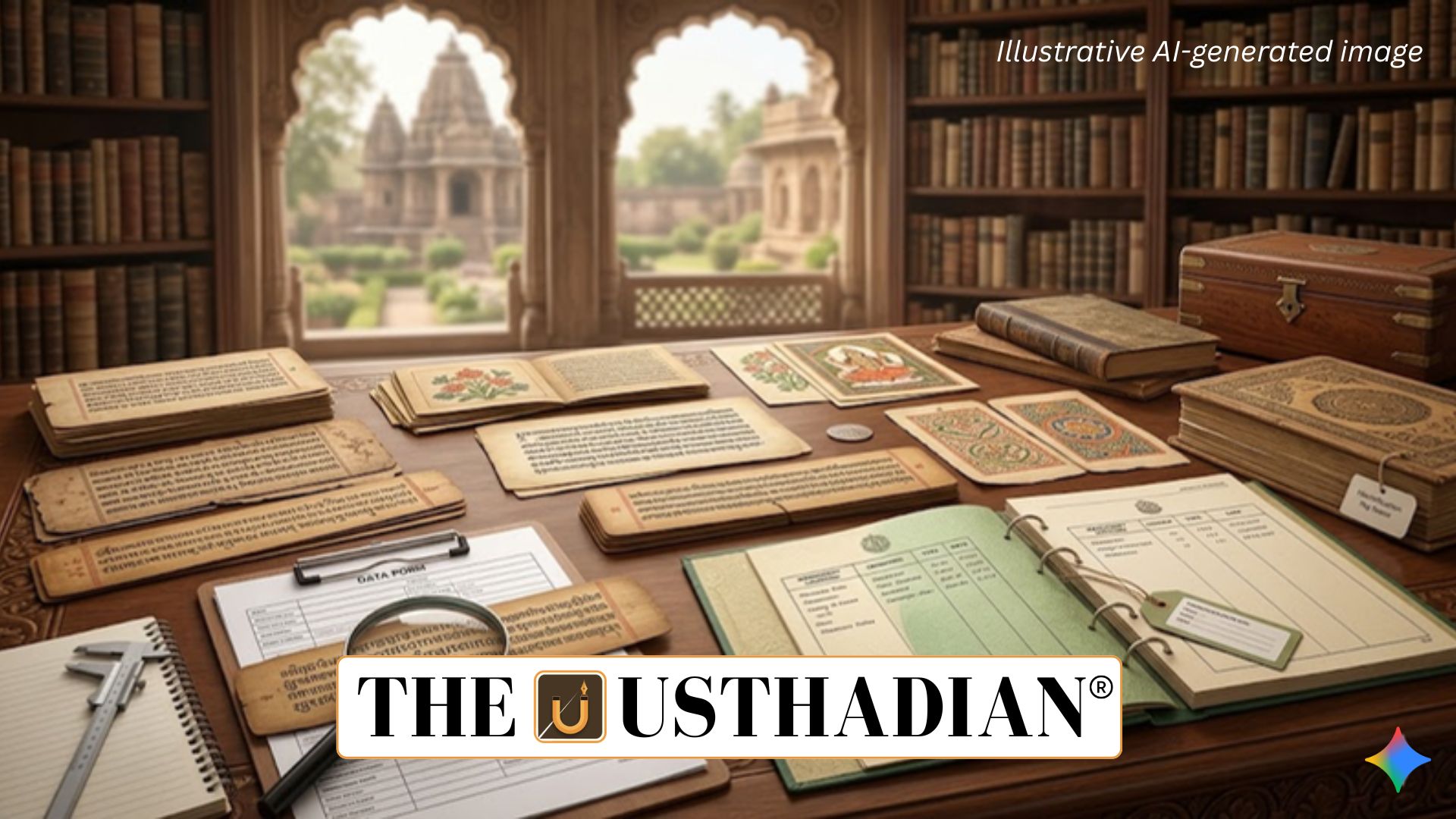
Nationwide Survey for Mapping India’s Manuscript Heritage: The Ministry of Culture has launched a nationwide survey to map India’s manuscript heritage. The survey aims to identify manuscripts across the country and document them systematically.
The collected data will be integrated into a national digital repository under the Gyan Bharatam Mission (GBM) portal. This initiative seeks to preserve rare documents and make them accessible for research and education.
A manuscript refers to a handwritten composition on materials such as paper, bark, cloth, metal, or palm leaf that is at least 75 years old. These documents often hold important scientific, historical, literary, and cultural knowledge.
Static GK fact: India is believed to possess millions of manuscripts in over 80 scripts and languages, making it one of the largest manuscript repositories in the world.
Importance of mapping manuscripts
Mapping manuscripts is crucial for preserving India’s cultural diversity and civilizational heritage. Many manuscripts remain undocumented in temples, monasteries, libraries, and private collections. Systematic documentation ensures that these valuable records are not lost or damaged.
The initiative will also help protect linguistic diversity, as manuscripts contain texts written in ancient and regional languages. Their preservation strengthens India’s cultural diplomacy and global cultural connections.
An example is the Gilgit Manuscripts, which are among the oldest surviving manuscripts of India. They provide significant insights into Buddhist traditions and strengthen India’s cultural links with East Asian countries.
Static GK Tip: The Gilgit Manuscripts were discovered in Gilgit (present-day Pakistan) and are written mainly in Buddhist Sanskrit texts on birch bark.
Reviving Indian knowledge systems
Manuscripts contain vast repositories of traditional Indian knowledge systems. They include texts on Ayurveda, Yoga, mathematics, astronomy, architecture, philosophy, and metallurgy.
One important example is the Bakhshali Manuscript, believed to date from the 3rd–4th century CE. It contains the earliest known use of the mathematical symbol for zero, which later became a cornerstone of modern mathematics.
Such manuscripts highlight India’s historic contributions to science, medicine, and mathematics. Their study can help revive ancient knowledge and integrate it with modern research.
Static GK fact: The concept of zero and the decimal place value system originated in ancient India and later spread to the world through Arab scholars.
Preventing intellectual piracy
A major objective of the survey is to prevent the smuggling and illegal trade of rare manuscripts. Many undocumented manuscripts have historically been stolen and sold in international markets.
By creating a national database, authorities can track, document, and protect valuable manuscripts. This also safeguards traditional knowledge systems from exploitation or intellectual piracy.
The Antiquities and Art Treasures Act, 1972 already prohibits the export of manuscripts older than 75 years, except with permission from the Central Government.
Gyan Bharatam Mission
The Gyan Bharatam Mission (GBM) is a national initiative aimed at preserving, digitising, and disseminating India’s manuscript heritage. It functions under the Ministry of Culture as a Central Sector Scheme.
GBM is a restructured version of the National Mission for Manuscripts launched in 2003. The mission works through five major pillars.
These include mapping manuscripts, conservation, digitisation and protection, decoding ancient texts, and promoting research and knowledge dissemination.
An important initiative under the mission is Gyan-Setu, an AI Innovation Challenge encouraging startups, students, and researchers to develop technological solutions for digitising and analysing manuscripts.
India is also engaged in international cooperation for preservation. Several Indian manuscripts are included in the UNESCO Memory of the World Register, including texts such as the Bhagavad Gita manuscripts and the Natyashastra.
Static Usthadian Current Affairs Table
Nationwide Survey for Mapping India’s Manuscript Heritage:
| Topic | Detail |
| Initiative | Nationwide survey to map India’s manuscript heritage |
| Ministry | Ministry of Culture |
| Mission | Gyan Bharatam Mission |
| Purpose | Identification, preservation and digitisation of manuscripts |
| Definition of Manuscript | Handwritten document at least 75 years old with cultural or historical value |
| Earlier Programme | National Mission for Manuscripts launched in 2003 |
| Key Knowledge Example | Bakhshali Manuscript showing early use of zero |
| Cultural Example | Gilgit Manuscripts connected to Buddhist heritage |
| Legal Protection | Antiquities and Art Treasures Act 1972 |
| Global Preservation | UNESCO Memory of the World Register |