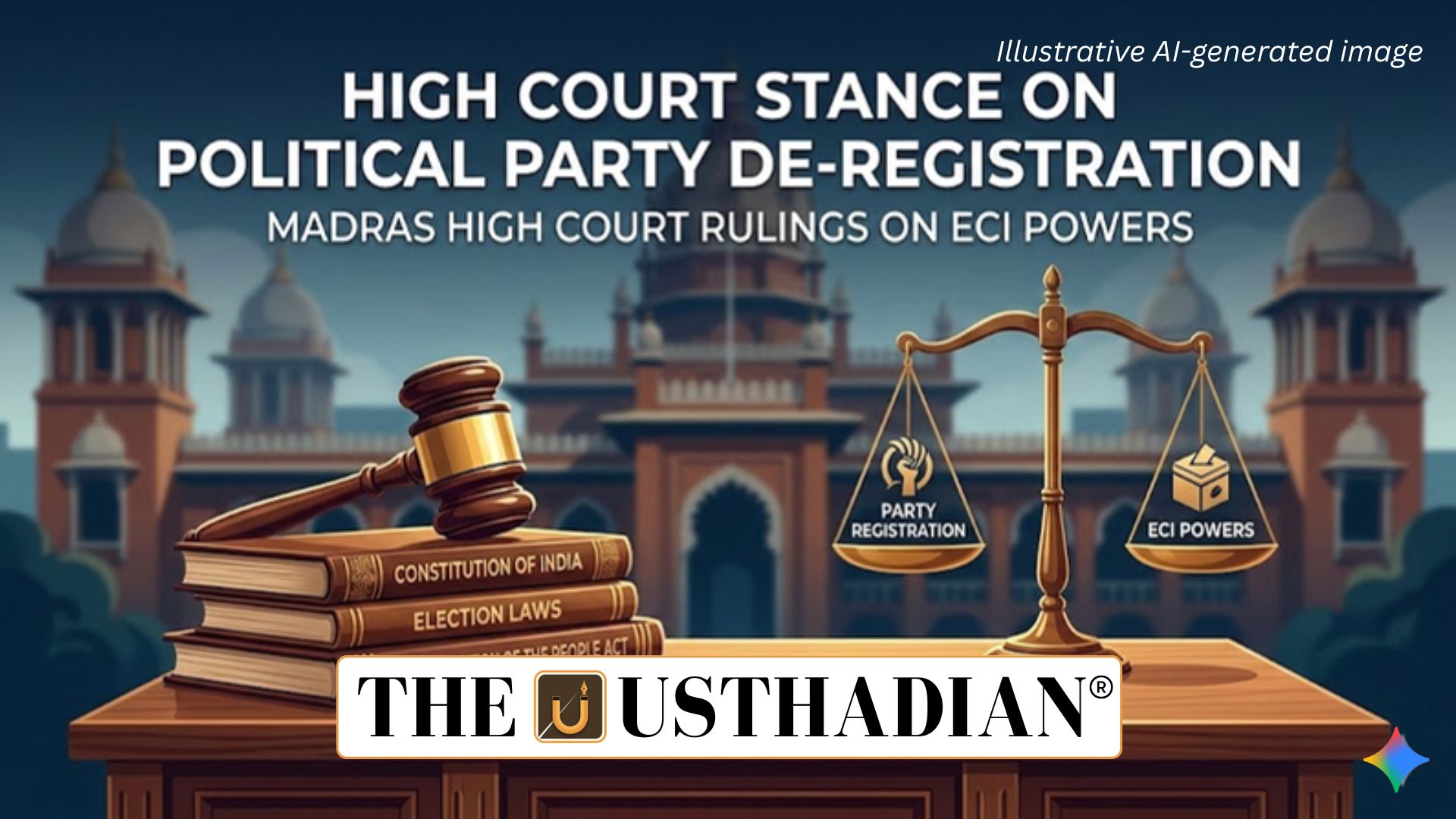
Background of the De-Registration Issue
Madras High Court Stance on ECI De-Registration of Political Parties: The Election Commission of India (ECI) recently de-registered several political parties for failing to contest Legislative Assembly or Parliamentary elections for six consecutive years. The move was part of an effort to maintain transparency and remove inactive parties from the electoral system.
Several Tamil Nadu-based parties including Tamizhaga Makkal Munnetra Kazhagam, Manithaneya Makkal Katchi, and Manithaneya Jananayaga Katchi challenged this decision. They filed writ petitions before the Madras High Court, questioning the legality of the ECI’s de-registration orders.
The petitioners argued that the ECI exceeded its authority under existing electoral laws. The case gained significance as it raised important constitutional questions regarding the powers of the Election Commission.
Madras High Court Decision
The Madras High Court refused to grant interim relief to the political parties. The court observed that granting a stay on the ECI’s orders would effectively allow the parties to contest the upcoming Tamil Nadu Assembly elections despite the pending legal dispute.
By declining interim relief, the court ensured that the ECI’s decision remains effective until further judicial review. The matter continues to raise debate about the balance between electoral regulation and political participation.
The decision also highlighted the judiciary’s cautious approach when dealing with electoral processes close to elections.
Legal Arguments Presented by the Petitioners
The political parties argued that Section 29A of the Representation of the People Act, 1951 only empowers the Election Commission to register political parties, not to de-register them.
They further claimed that Section 21 of the General Clauses Act, 1897 cannot be used to justify the withdrawal of registration powers. According to them, applying this provision would extend the ECI’s authority beyond what Parliament originally intended.
The petitioners relied heavily on the Supreme Court judgment in Indian National Congress vs Institute of Social Welfare (2002). This landmark case limited the circumstances in which political parties could be de-registered.
Supreme Court Guidelines on De-Registration
In the 2002 Supreme Court judgement, the Court ruled that de-registration of political parties is permissible only under exceptional circumstances. These include situations involving fraud, forgery, or false declarations during registration.
Another condition is when a political party loses allegiance to the Constitution of India, including principles such as socialism, secularism, and democracy.
Static GK fact: The Supreme Court of India was established on 26 January 1950, replacing the Federal Court of India and the Judicial Committee of the Privy Council as the highest court of the country.
ECI Justification and Constitutional Authority
The Election Commission of India defended its decision by referring to guidelines issued in 2014 under Article 324 of the Constitution. These guidelines require political parties to contest at least one election within a six-year block period.
The ECI argued that the 2002 Supreme Court judgement preceded these guidelines, which were framed to improve electoral discipline and remove non-functional parties from the political system.
Article 324 grants the ECI broad powers to supervise and conduct elections to Parliament, State Legislatures, and the offices of President and Vice-President.
Static GK Tip: The Election Commission of India was established on 25 January 1950, and this day is observed annually as National Voters’ Day in India.
The final outcome of the case may clarify the extent of the Election Commission’s authority to regulate political parties, which is crucial for maintaining the integrity of India’s democratic process.
Static Usthadian Current Affairs Table
Madras High Court Stance on ECI De-Registration of Political Parties:
| Topic | Detail |
| Issue | De-registration of inactive political parties |
| Authority Involved | Election Commission of India |
| Court Involved | Madras High Court |
| Key Law | Representation of the People Act 1951 |
| Constitutional Provision | Article 324 of the Constitution |
| Additional Law | General Clauses Act 1897 |
| Landmark Case | Indian National Congress vs Institute of Social Welfare (2002) |
| ECI Guideline | Parties must contest elections at least once in six years |
| Concern Raised | Legality of ECI’s power to de-register parties |
| Relevance | Electoral regulation and political party accountability |