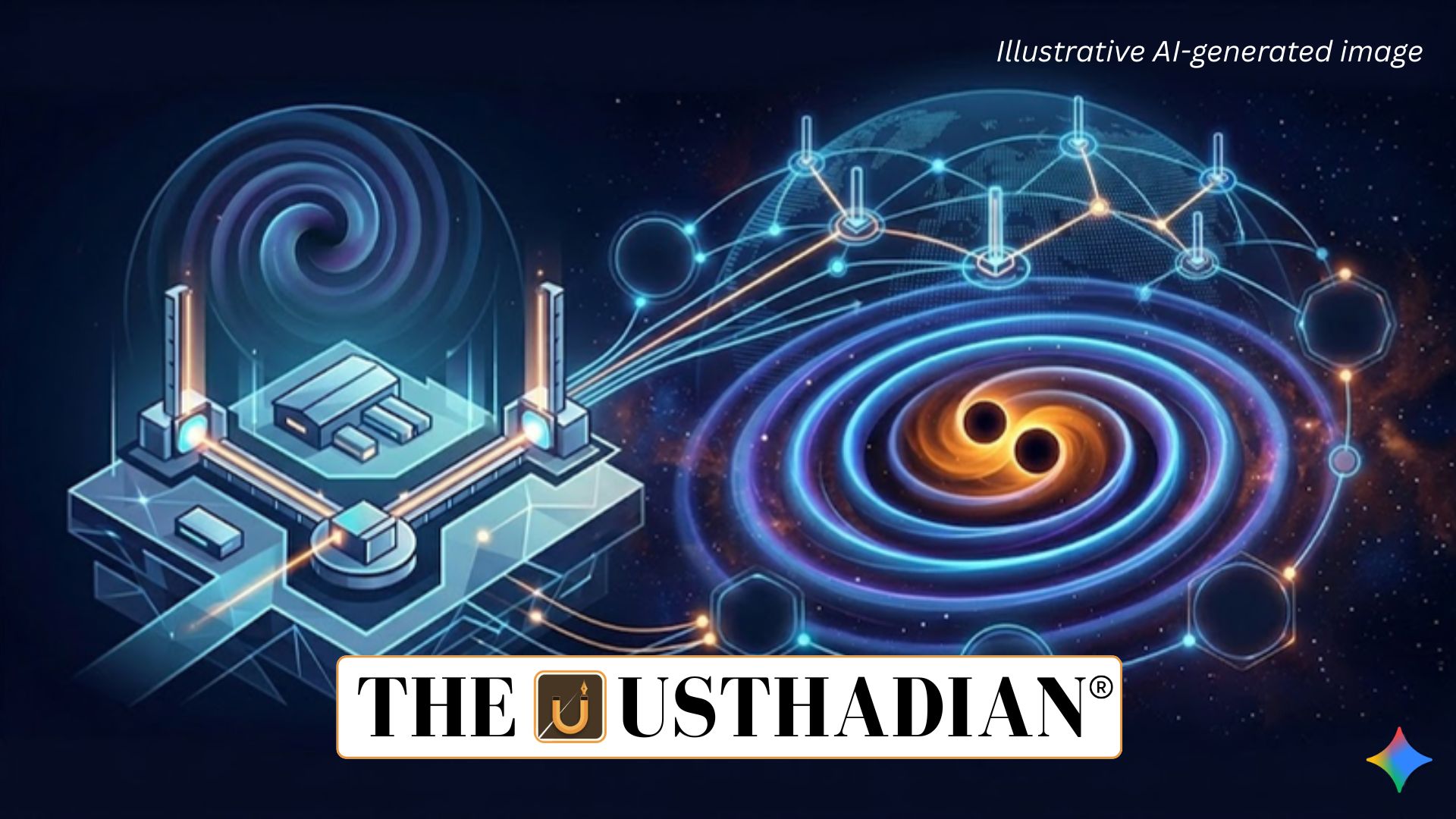
What is LIGO
LIGO India Strengthens Gravitational Wave Astronomy: The Laser Interferometer Gravitational Wave Observatory (LIGO) is an advanced scientific facility designed to detect gravitational waves. These waves are tiny ripples in space-time produced by violent cosmic events such as merging black holes or colliding neutron stars.
In 1916, Albert Einstein predicted gravitational waves in his General Theory of Relativity. These waves travel at the speed of light and carry information about their origin and the nature of gravity.
Static GK fact: The General Theory of Relativity was published in 1915 and revolutionized modern physics.
Working Principle of LIGO
LIGO works on the principle of laser interferometry. It uses two perpendicular arms, each about 4 kilometres long, arranged in an L-shape.
A laser beam is split and sent down these vacuum tunnels. The beams reflect off mirrors and recombine to form an interference pattern. If a gravitational wave passes, it causes a minuscule stretching or compressing of space, altering this pattern.
The changes measured are smaller than the diameter of a proton, highlighting the extreme sensitivity of the instrument.
Static GK Tip: The first direct detection of gravitational waves was announced in 2015 by LIGO-USA.
LIGO India Project
The LIGO-India project was approved by the Government of India in 2016. It will be constructed at Aundha in Hingoli district of Maharashtra. Recently, Larsen & Toubro (L&T) secured the contract from the Department of Atomic Energy (DAE) to build the facility.
The project is being developed jointly by the Department of Atomic Energy (DAE) and the Department of Science and Technology (DST). It operates under a Memorandum of Understanding with the National Science Foundation (NSF), USA.
Major Indian scientific institutions involved include the Institute of Plasma Research (IPR), Gandhinagar, Inter-University Centre for Astronomy and Astrophysics (IUCAA), Pune, and Raja Ramanna Centre for Advanced Technology (RRCAT), Indore.
Static GK fact: The Department of Atomic Energy functions directly under the Prime Minister of India.
Global Network of Observatories
LIGO-India will become part of the global gravitational wave network. Other major observatories include LIGO (USA), VIRGO (Italy), and KAGRA (Japan).
The first detection of gravitational waves occurred at LIGO-USA in 2015, confirming Einstein’s prediction after nearly a century. A global network improves source localization accuracy and enhances astrophysical research.
Static GK Tip: VIRGO is located near Pisa in Italy, while KAGRA is built underground in Japan.
Significance for India
LIGO-India will strengthen India’s position in astrophysical research and advanced physics. It will promote high-end technology development, precision engineering, and vacuum systems expertise.
The project encourages industrial collaboration, as seen in L&T’s involvement. It also enhances India’s scientific diplomacy and international prestige by contributing to frontier research.
The facility will support training of young scientists and create opportunities in optics, data science, and quantum measurement technologies.
LIGO-India represents a major step in positioning India among the leading nations in gravitational wave astronomy.
Static Usthadian Current Affairs Table
LIGO India Strengthens Gravitational Wave Astronomy:
| Topic | Detail |
| Project Name | LIGO-India |
| Location | Aundha, Hingoli district, Maharashtra |
| Approval Year | 2016 |
| Implementing Agencies | Department of Atomic Energy and Department of Science and Technology |
| International Partner | National Science Foundation, USA |
| Construction Partner | Larsen & Toubro |
| Scientific Objective | Detection of gravitational waves |
| Global Observatories | LIGO USA, VIRGO Italy, KAGRA Japan |
| First Detection of Gravitational Waves | 2015 |
| Theoretical Prediction | Albert Einstein, 1916 |