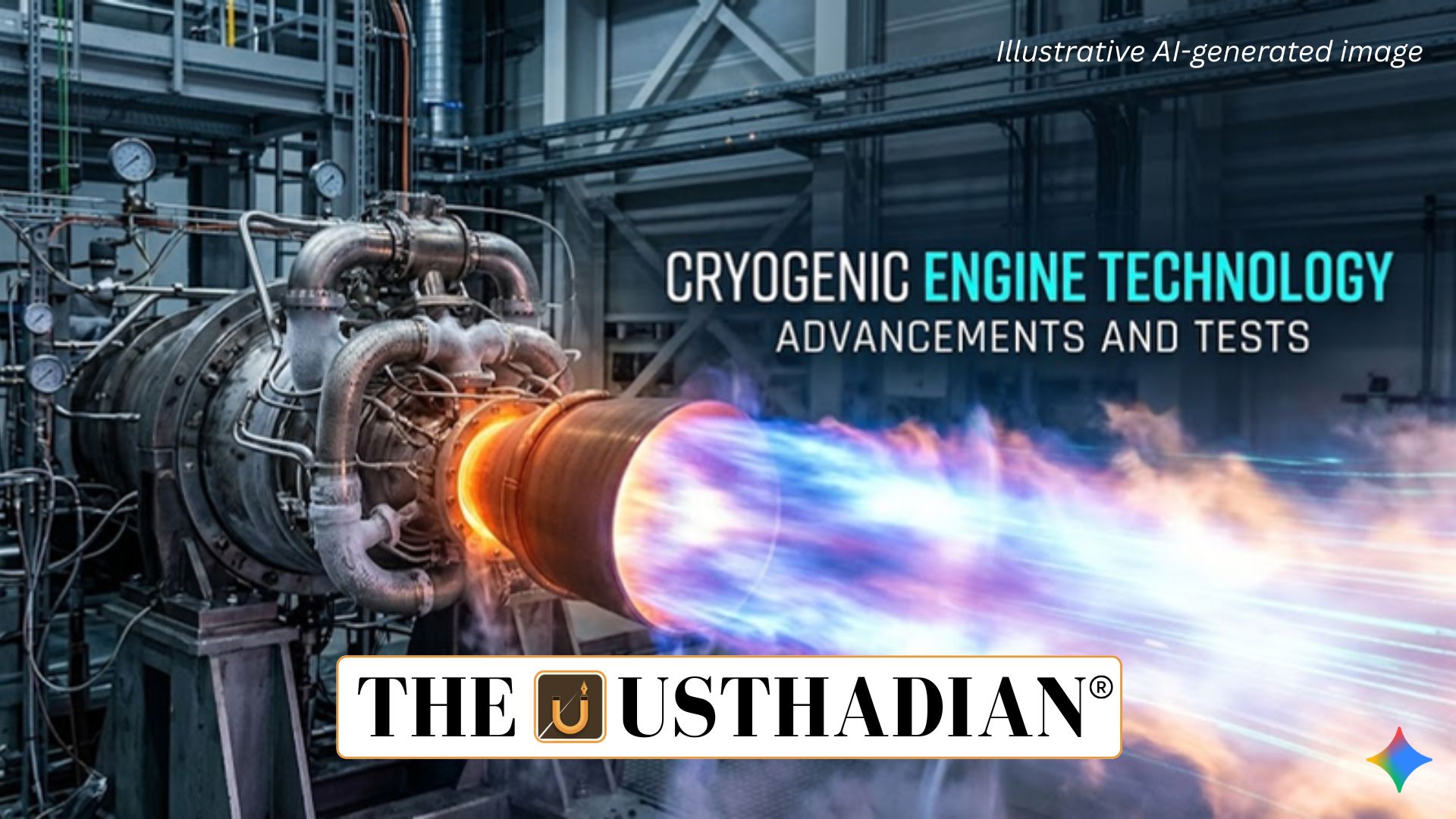
Breakthrough Ground Test by ISRO
ISRO Advances Cryogenic Engine Capability: The Indian Space Research Organisation (ISRO) recently conducted a successful ground test of the CE20 cryogenic engine, marking an important step in strengthening India’s advanced launch vehicle capability. The CE20 engine is an indigenously developed propulsion system designed for the third stage of the LVM3 launch vehicle.
This engine is crucial for improving heavy payload launch capacity and supporting future human spaceflight missions such as the Gaganyaan Programme. The successful test demonstrates India’s growing expertise in high-end rocket propulsion technology.
Static GK fact: ISRO was established in 1969 and operates under the Department of Space, Government of India.
Significance of the CE20 Cryogenic Engine
The CE20 engine is a powerful cryogenic rocket engine that plays a critical role in the Geosynchronous Satellite Launch Vehicle Mark III (LVM3). This launch vehicle is currently India’s heaviest rocket, capable of carrying large communication satellites and future crew missions.
With the successful development of cryogenic propulsion, India joined a small group of technologically advanced nations possessing this capability. Only six countries—USA, Russia, Japan, France, China, and India—have mastered cryogenic rocket engine technology.
The CE20 engine enhances payload capacity, improves launch efficiency, and supports India’s goal of achieving self-reliance in space technology.
Static GK Tip: LVM3 was earlier known as GSLV Mk III and is designed to carry payloads of about 4 tonnes to Geosynchronous Transfer Orbit (GTO).
Understanding Cryogenic Engines
A cryogenic engine is a type of rocket propulsion system that uses liquefied gases stored at extremely low temperatures as fuel and oxidizer. The term “cryogenic” refers to substances kept at temperatures below –150°C.
These engines usually use Liquid Hydrogen (LH2) as fuel and Liquid Oxygen (LOX) as the oxidizer. These propellants are highly efficient because they generate very high energy output during combustion.
Maintaining these fuels requires advanced thermal insulation and storage technology, making cryogenic propulsion one of the most complex rocket technologies in the world.
Static GK fact: Liquid hydrogen is considered one of the most efficient rocket fuels due to its high specific impulse.
Working Principle of Cryogenic Propulsion
A cryogenic engine works on the principle of reaction propulsion, based on Newton’s Third Law of Motion. According to this law, every action has an equal and opposite reaction.
In the engine, liquid hydrogen and liquid oxygen are pumped into a combustion chamber where they ignite and produce high-temperature exhaust gases. These gases are expelled at extremely high speeds through a nozzle.
The rapid expulsion of gases generates thrust, pushing the rocket forward into space. This efficient propulsion system enables rockets to carry heavier satellites and deeper space missions.
Static GK Tip: Newton’s Third Law of Motion states that for every action there is an equal and opposite reaction, which forms the basis of rocket propulsion.
Static Usthadian Current Affairs Table
ISRO Advances Cryogenic Engine Capability:
| Topic | Detail |
| Organisation | Indian Space Research Organisation (ISRO) |
| Engine | CE20 cryogenic rocket engine |
| Launch Vehicle | LVM3 (earlier GSLV Mk III) |
| Technology Type | Cryogenic propulsion |
| Propellants Used | Liquid Hydrogen (LH2) and Liquid Oxygen (LOX) |
| Temperature Requirement | Below -150°C |
| Major Application | Third stage of LVM3 launch vehicle |
| Future Mission Link | Gaganyaan human spaceflight programme |
| Countries with Technology | USA, Russia, Japan, France, China, India |
| Scientific Principle | Newton’s Third Law of Motion |