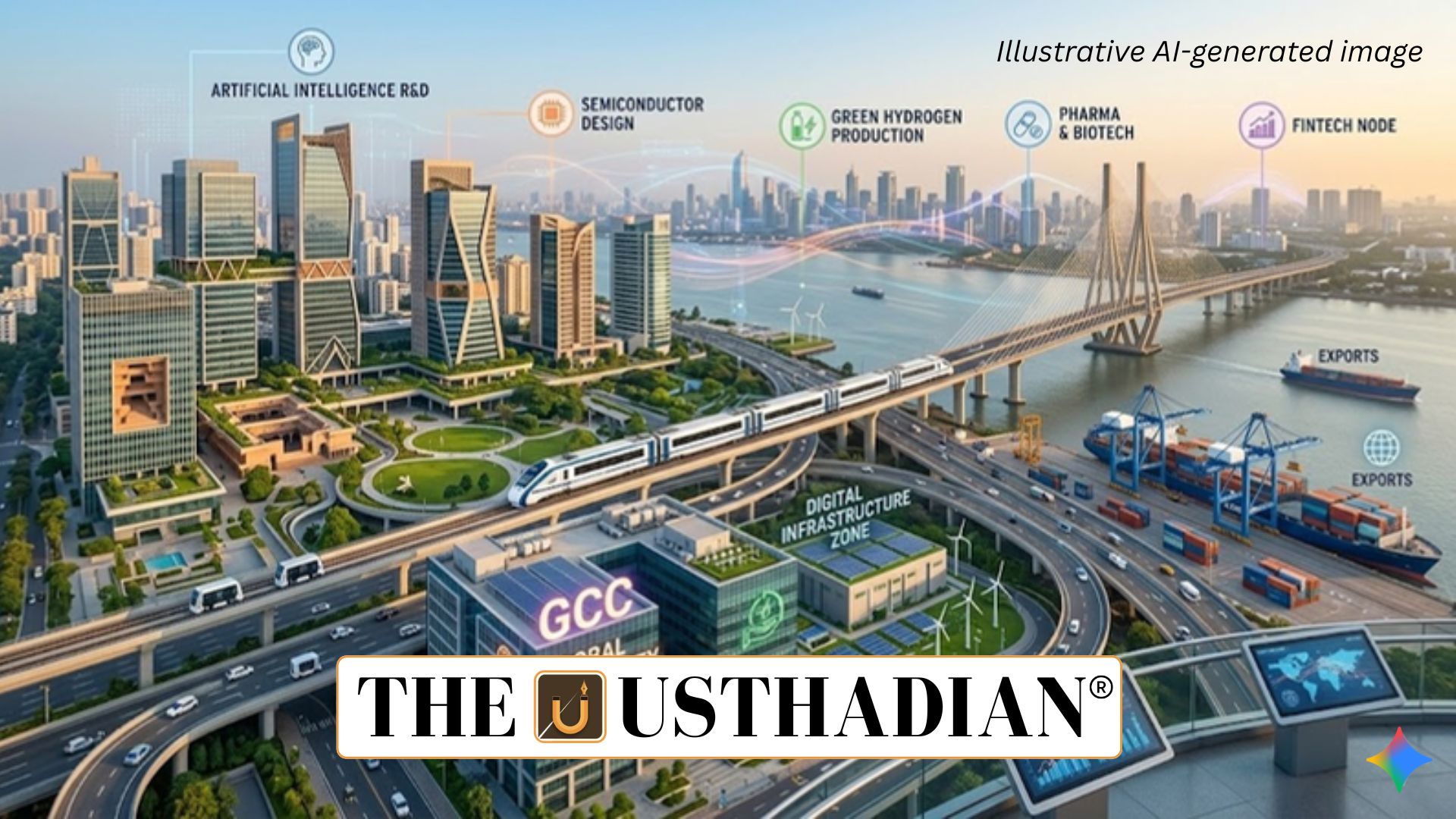
Expanding India’s Business Ecosystem
India Rising as a Global Business Hub: India is steadily emerging as a major global business destination due to consistent policy reforms and a growing domestic market. The Union Budget 2026–27 introduced several measures to improve the Ease of Doing Business (EoDB) by simplifying compliance, improving tax certainty, and strengthening digital trade systems.
These reforms aim to make India a competitive investment hub while encouraging both domestic and foreign companies to expand operations. The focus is on reducing litigation, simplifying regulations, and improving business transparency.
Static GK fact: India currently ranks among the top five largest economies in the world based on nominal GDP, reflecting its growing economic influence.
Strengthening Domestic Manufacturing
A major objective of India’s business strategy is scaling domestic manufacturing to reduce import dependence. Key sectors include electronics, automobiles, pharmaceuticals, and defence manufacturing, which are central to the Atmanirbhar Bharat initiative.
Government policies support domestic production through incentives, infrastructure development, and improved logistics networks. Increasing manufacturing capacity will also help India integrate deeper into global supply chains.
Static GK Tip: The Make in India initiative, launched in 2014, aims to transform India into a global manufacturing hub and increase the manufacturing sector’s share in GDP.
Building Export Resilience
Global trade disruptions and supply chain challenges have highlighted the need for export diversification. India is focusing on expanding exports in sectors such as electronics, pharmaceuticals, and engineering goods.
Improving trade facilitation through digital documentation and faster customs clearance helps Indian businesses access international markets more efficiently. Diversified export markets also reduce vulnerability to global economic shocks.
Static GK fact: India’s major export destinations include the United States, United Arab Emirates, and European Union, which together account for a significant share of total exports.
Institutional and Regulatory Reforms
Institutional reforms have created a technology-driven and investor-friendly business environment. Schemes like Start-up India and the Credit Guarantee Scheme support entrepreneurship by improving access to finance and reducing risks for lenders.
The Jan Vishwas Amendment Act 2023 marked an important regulatory shift by decriminalizing several minor business offences and replacing them with civil penalties. This reform reduces fear of litigation and encourages smoother business operations.
Additionally, consolidation of 29 labour laws into four labour codes simplifies employment regulations and provides greater clarity for industries.
Static GK fact: India has one of the largest startup ecosystems in the world, with thousands of registered startups across sectors such as fintech, healthtech, and edtech.
Taxation Reforms and Economic Growth
Tax reforms play a key role in improving India’s investment climate. The introduction of GST 2.0 with a simplified two-rate structure aims to reduce tax complexity and enhance compliance.
The Union Budget 2026–27 also proposed reducing the Minimum Alternate Tax (MAT) from 15% to 14% and treating it as the final tax liability. This move improves corporate predictability and reduces disputes.
Such reforms support India’s broader goal of achieving a 5 trillion dollar economy, while also improving public revenue for social welfare and infrastructure development.
Static GK Tip: The Goods and Services Tax (GST) was introduced in 2017 as India’s largest indirect tax reform, replacing multiple central and state taxes.
Static Usthadian Current Affairs Table
India Rising as a Global Business Hub:
| Topic | Detail |
| Budget reform | Union Budget 2026–27 introduced measures to improve ease of doing business |
| Business environment | Focus on digital trade facilitation and reduced compliance burden |
| Manufacturing goal | Expansion in electronics, automobiles, pharmaceuticals and defence sectors |
| Export strategy | Diversification of markets to strengthen resilience |
| Institutional reform | Start-up India and Credit Guarantee Scheme support entrepreneurs |
| Regulatory reform | Jan Vishwas Amendment Act 2023 decriminalized minor offences |
| Labour reform | Consolidation of labour laws into four labour codes |
| Tax reform | GST 2.0 simplified the tax structure |
| Corporate tax change | MAT reduced from 15% to 14% in Budget 2026–27 |
| Economic target | India aims to reach a 5 trillion dollar economy |