Early Historical Contacts
India Iran Historical and Civilizational Links: India and Iran share deep civilizational ties dating back to ancient times. The earliest connections emerged during the expansion of the Achaemenid Empire into the northwestern parts of the Indian subcontinent.
Cyrus the Great (558–530 BCE) was the first Persian ruler to enter India, capturing the Gandhara region. Later, Darius I (522–486 BCE) annexed parts of the Indus Valley, including Punjab and Sindh, around 518 BCE.
Static GK fact: The Achaemenid Empire was one of the largest empires in ancient history, spanning three continents.
Influence on Administration
Persian administrative practices significantly influenced Indian governance. The centralized system of the Achaemenids inspired Chandragupta Maurya in establishing the Mauryan Empire.
Even during colonial times, Persian remained the official language of administration and judiciary under the East India Company until reforms in 1832–37.
Static GK Tip: The Mauryan Empire is considered India’s first large-scale centralized state.
Literary and Linguistic Exchange
There are deep similarities between India’s Rigveda and Iran’s Avesta, indicating shared Indo-Iranian roots. During the Mughal period, Persian became the court language, especially under Akbar in 1582.
Several commonly used Indian words such as kagaz, vakil, diwani, tahsil, mohalla are derived from Persian. This linguistic blending created a rich Indo-Persian literary tradition.
Artistic Contributions
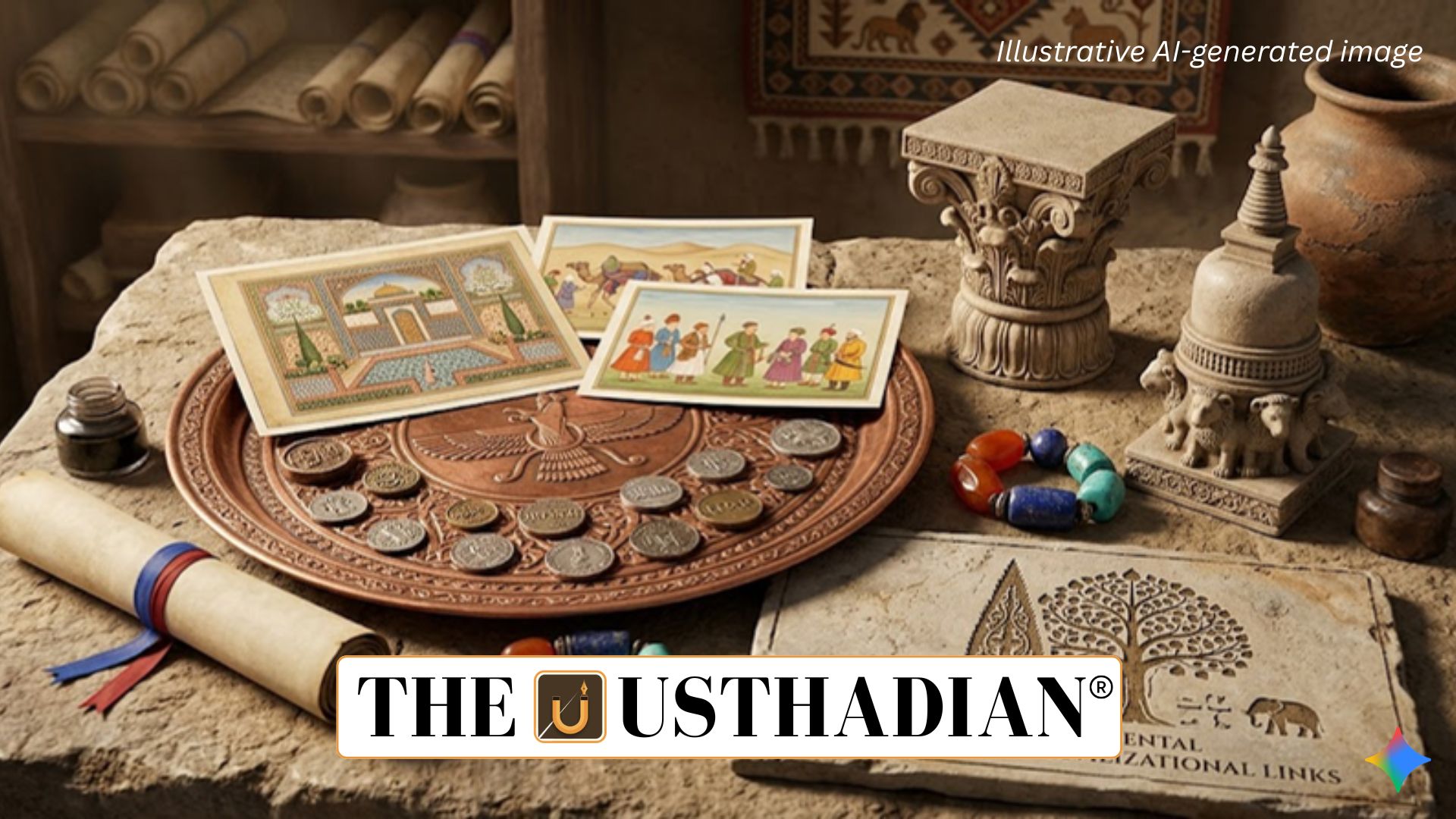
Persian influence shaped Indian art forms, particularly during the Mughal era. Emperor Humayun invited Persian artists like Abd al-Samad and Mir Sayyid Ali, leading to the development of miniature painting traditions.
These artworks combined Indian themes with Persian techniques, creating a unique visual culture.
Static GK fact: Mughal miniature paintings are known for their fine detailing and vibrant colors.
Architectural Impact
Persian styles influenced Indian architecture from the Mauryan to Mughal periods. The Kharosthi script, derived from Iranian writing, was used in northwestern India, including in some Ashokan edicts.
Mughal architecture prominently adopted Persian elements such as charbagh gardens, symmetrical layouts, and water channels. Monuments like the Taj Mahal and Humayun’s Tomb reflect this fusion.
Static GK Tip: The charbagh garden design symbolizes the concept of paradise in Islamic architecture.
Cultural and Spiritual Exchange
Cultural exchange extended to music and spirituality. Persian musical instruments like the sitar and santur became integral to Indian music traditions.
Genres such as ghazal and qawwali evolved from Persian roots. The spread of Sufism further strengthened Indo-Iranian cultural bonds, promoting ideas of unity and devotion.
Contemporary Relevance
These historical ties continue to influence modern India-Iran relations, especially in areas of culture, trade, and connectivity projects like Chabahar Port.
Understanding these shared roots highlights the long-standing cultural bridge between the two civilizations.
Static Usthadian Current Affairs Table
India Iran Historical and Civilizational Links:
| Topic | Detail |
| Early Contact | Achaemenid Empire expansion into India |
| Key Rulers | Cyrus the Great, Darius I |
| Administrative Influence | Inspired Mauryan governance system |
| Official Language | Persian till 1830s under British |
| Literary Link | Rigveda and Avesta similarities |
| Architectural Feature | Charbagh garden style |
| Art Contribution | Mughal miniature paintings |
| Cultural Elements | Sufism, ghazal, qawwali |