Policy Shift in Waste Management
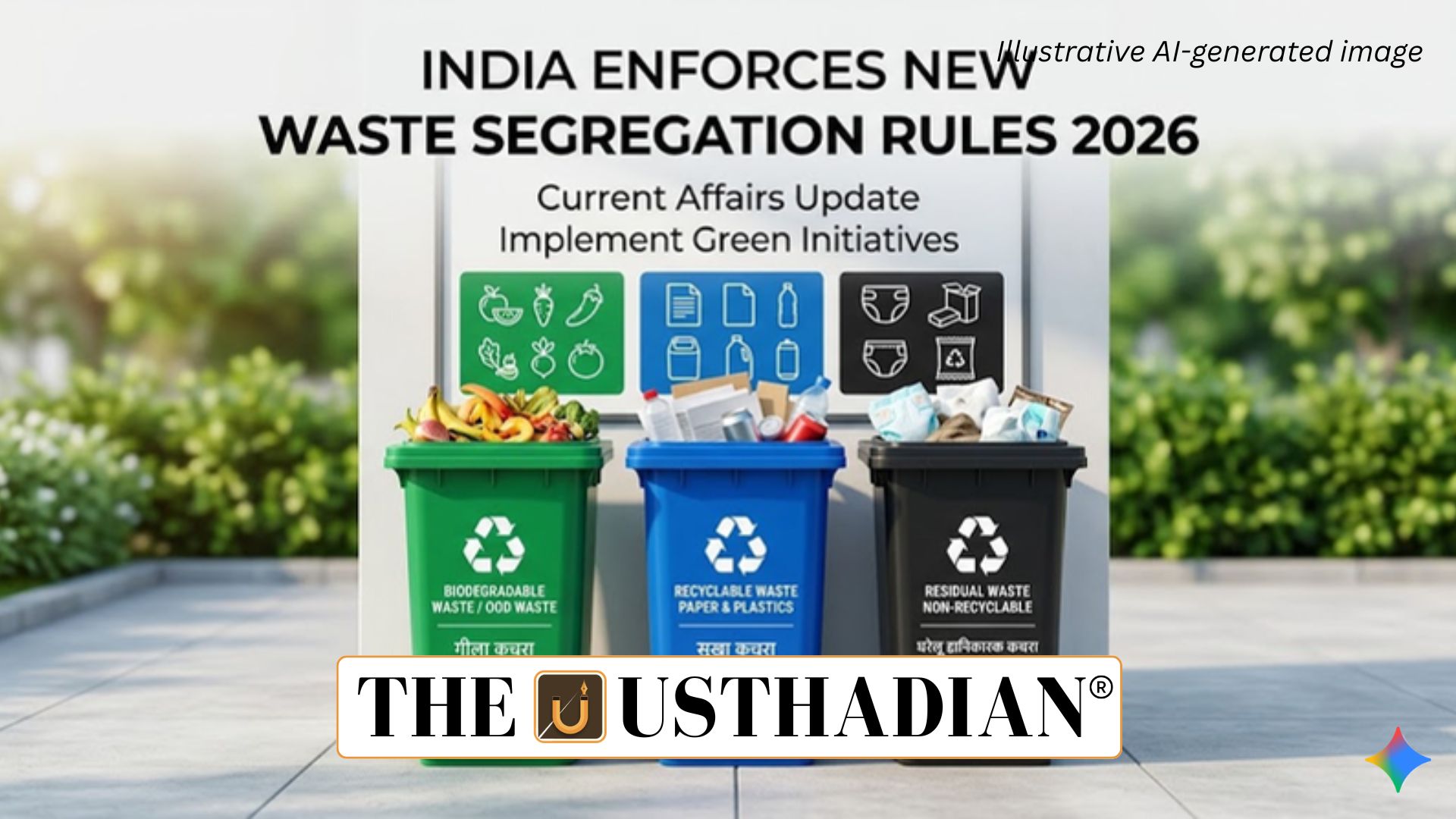
India Enforces New Waste Segregation Rules 2026: India notified the Solid Waste Management Rules 2026 on January 27, 2026, replacing the earlier 2016 framework. The rules came into force from April 1, 2026, marking a major shift in waste governance.
The policy focuses on scientific waste segregation, digital monitoring, and sustainable disposal practices. It strengthens accountability across households, industries, and local bodies.
Static GK fact: The Ministry of Environment, Forest and Climate Change (MoEFCC) is responsible for environmental policies and was established in 1985.
Four Stream Waste Segregation
A key reform is the mandatory four-stream segregation at source. All households and institutions must separate waste into wet, dry, sanitary, and special care waste.
This structured segregation improves recycling efficiency and reduces pressure on landfills. It also ensures safer handling of hazardous and sanitary waste.
The move aligns with global practices for efficient urban waste systems. It promotes decentralized waste processing at the source level.
Static GK Tip: Biodegradable waste decomposes naturally, while non-biodegradable waste persists in the environment for longer periods.
Circular Economy Approach
The rules strongly emphasize the concept of a circular economy, where waste is reused, recycled, and repurposed. This reduces dependence on raw materials and minimizes environmental damage.
A major feature is the introduction of Extended Bulk Waste Generator Responsibility (EBWGR). Large generators like hotels, institutions, and residential complexes must manage their waste lifecycle.
They are responsible for collection, segregation, transportation, and eco-friendly disposal. This shifts the burden from municipalities to generators.
Static GK fact: The concept of circular economy gained prominence through global sustainability frameworks like the UN Sustainable Development Goals (SDGs).
Digital Monitoring System
The government has introduced a centralized online tracking system for waste management. All stages, from collection to disposal, will be digitally monitored.
This system enables real-time tracking, improving transparency and compliance. Authorities can quickly identify inefficiencies and enforce accountability.
Digital integration ensures better coordination between urban local bodies and waste processors. It also enhances data-driven decision-making.
Static GK Tip: India’s push for digital governance is supported by initiatives like Digital India, launched in 2015.
Industrial Participation and RDF Targets
Industries play a crucial role under the new rules, especially in energy recovery. The use of Refuse Derived Fuel (RDF) is now being promoted.
The current substitution rate of 5% is targeted to increase to 15% within six years. This reduces dependence on fossil fuels and supports alternative energy.
Sectors like cement plants and waste-to-energy units are key contributors. This also aligns with India’s climate commitments.
Static GK fact: RDF is produced from processed municipal solid waste and is used as an alternative fuel.
Role of Local Bodies
The rules clearly define responsibilities for urban and rural local bodies, along with state and central agencies. They are tasked with implementation and monitoring.
A graded system for faster land allocation for waste processing units has been introduced. This ensures quicker infrastructure development.
Stronger governance mechanisms will help achieve cleaner cities and sustainable waste systems.
Static Usthadian Current Affairs Table
India Enforces New Waste Segregation Rules 2026:
| Topic | Detail |
| Notification Date | January 27, 2026 |
| Implementation Date | April 1, 2026 |
| Key Reform | Four-stream waste segregation |
| Waste Categories | Wet, dry, sanitary, special care |
| New Concept | Circular economy approach |
| Responsibility Model | EBWGR for bulk generators |
| Digital Feature | Centralized online tracking system |
| RDF Target | Increase from 5% to 15% |
| Governing Body | MoEFCC |
| Objective | Sustainable and efficient waste management |