Understanding Digital Public Infrastructure
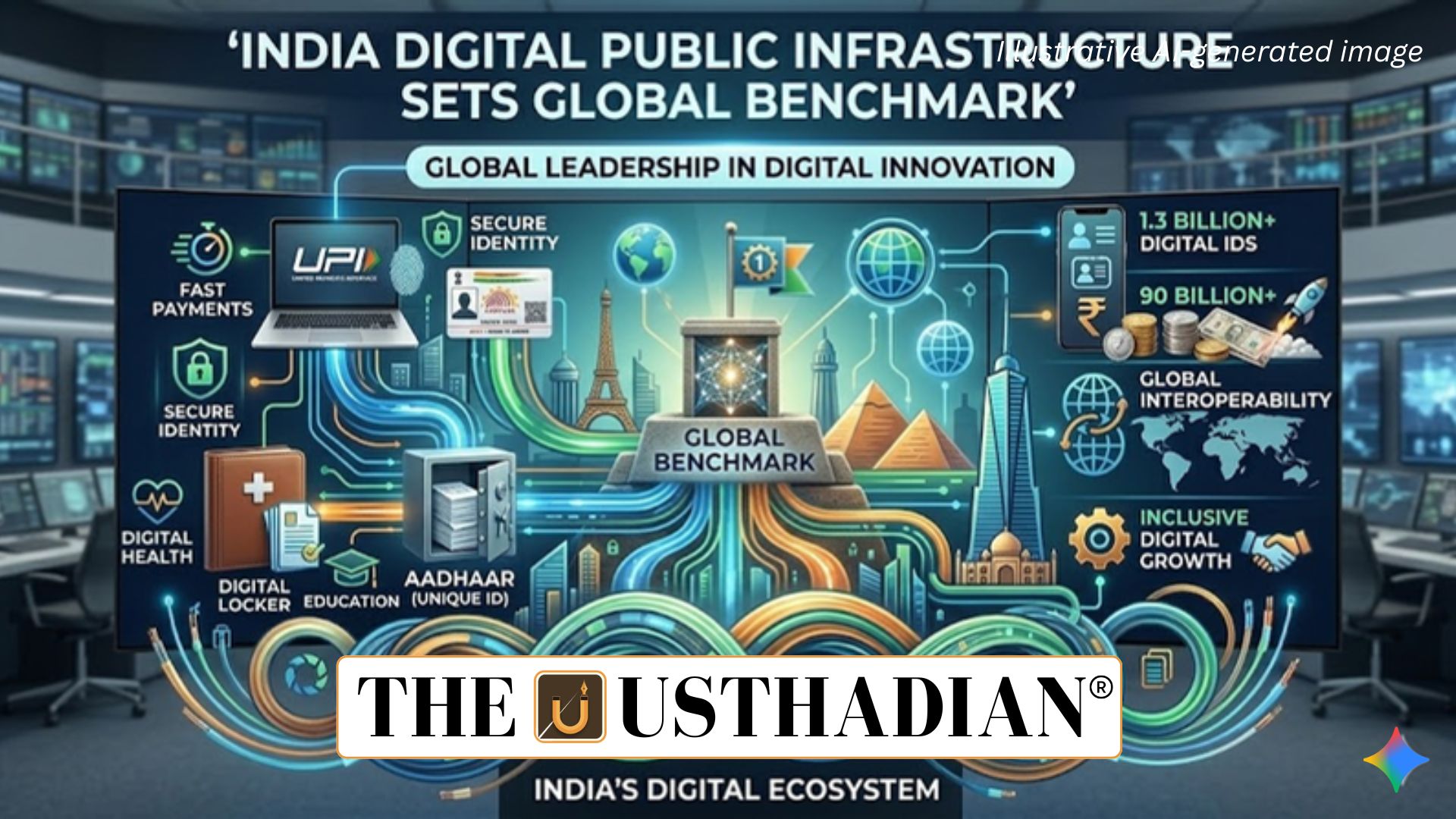
India Digital Public Infrastructure Sets Global Benchmark: Digital Public Infrastructure (DPI) refers to foundational digital systems that enable secure interactions between citizens, businesses, and governments. The United Nations describes DPI as digital platforms that provide identity verification, payment systems, and data exchange frameworks.
A well-designed DPI system must follow three key principles: inclusivity, interoperability, and public governance. Inclusivity ensures services reach citizens regardless of geography or income. Interoperability allows multiple digital systems to interact through open APIs, improving efficiency and innovation.
Static GK fact: India’s Aadhaar, launched in 2009, is the world’s largest biometric identification system with over 1.3 billion enrolled citizens.
India Stack and Population Scale Innovation
India’s digital transformation is built on the India Stack, a set of interoperable digital platforms designed for large-scale public service delivery. These include Aadhaar for identity, UPI for payments, and DigiLocker for digital documents.
The most visible success is the Unified Payments Interface (UPI) developed by the National Payments Corporation of India (NPCI). UPI allows instant bank-to-bank transfers using mobile applications, making digital payments accessible even for small transactions.
India’s DPI handles billions of digital transactions every month, demonstrating its capacity to operate at a population scale of over 1.4 billion people.
Static GK Tip: NPCI was established in 2008 under the supervision of the Reserve Bank of India (RBI) and the Indian Banks’ Association (IBA).
Economic and Governance Impact
India’s DPI ecosystem has significantly improved welfare delivery and governance efficiency. The Public Financial Management System (PFMS) uses digital infrastructure to transfer subsidies and welfare payments directly to beneficiaries.
Through this system, the government has reportedly saved more than ₹4.31 lakh crore by reducing leakages, duplication, and corruption in subsidy distribution.
Another remarkable impact is seen in digital payments. UPI accounts for nearly 49% of global real-time payment transactions, making India the world leader in instant digital payments.
Expanding Sectoral Applications
India’s DPI model has expanded beyond payments into multiple sectors. In healthcare, the CoWIN platform successfully managed vaccination data during the COVID-19 pandemic, enabling large-scale vaccine scheduling and certification.
Telemedicine services are supported by eSanjeevani, while the DIKSHA platform provides digital learning resources for students and teachers across India.
The Open Network for Digital Commerce (ONDC) aims to democratize online commerce by reducing platform monopolies and enabling small businesses to participate in digital marketplaces.
Similarly, the e-Courts project is modernizing India’s judicial system through digitized case management and online access to court records.
India’s DPI as Global Digital Diplomacy
India is now exporting its DPI model to the world as part of digital cooperation and diplomacy. The government has signed memorandums of understanding with more than 24 countries to share digital infrastructure solutions.
The UPI payment system has already been integrated into several countries including UAE, Singapore, Bhutan, Nepal, Sri Lanka, France, Mauritius, and Qatar to enable seamless cross-border payments.
Another global innovation is the Modular Open-Source Identity Platform (MOSIP) developed in India. MOSIP allows countries to build their own digital identity systems while maintaining sovereignty over citizen data.
Currently, more than 25 nations are exploring or adopting MOSIP for their national digital identity frameworks.
Static GK fact: India hosts the G20 Global Partnership for Financial Inclusion initiatives, promoting digital financial systems worldwide.
Static Usthadian Current Affairs Table
India Digital Public Infrastructure Sets Global Benchmark:
| Topic | Detail |
| Concept | Digital Public Infrastructure enables digital identity, payments, and data exchange |
| Core Framework | India Stack including Aadhaar, UPI, DigiLocker |
| Major Payment System | Unified Payments Interface developed by NPCI |
| Global Share | UPI accounts for around 49% of global real-time payments |
| Welfare Efficiency | PFMS saved over ₹4.31 lakh crore through direct transfers |
| Health Infrastructure | CoWIN and eSanjeevani support digital healthcare |
| Digital Commerce | ONDC promotes open and competitive e-commerce |
| Global Expansion | India has DPI cooperation agreements with over 24 countries |
| Cross-Border Payments | UPI operational in eight countries |
| Identity Innovation | MOSIP adopted or explored by more than 25 nations |