Breakthrough Solar Observation
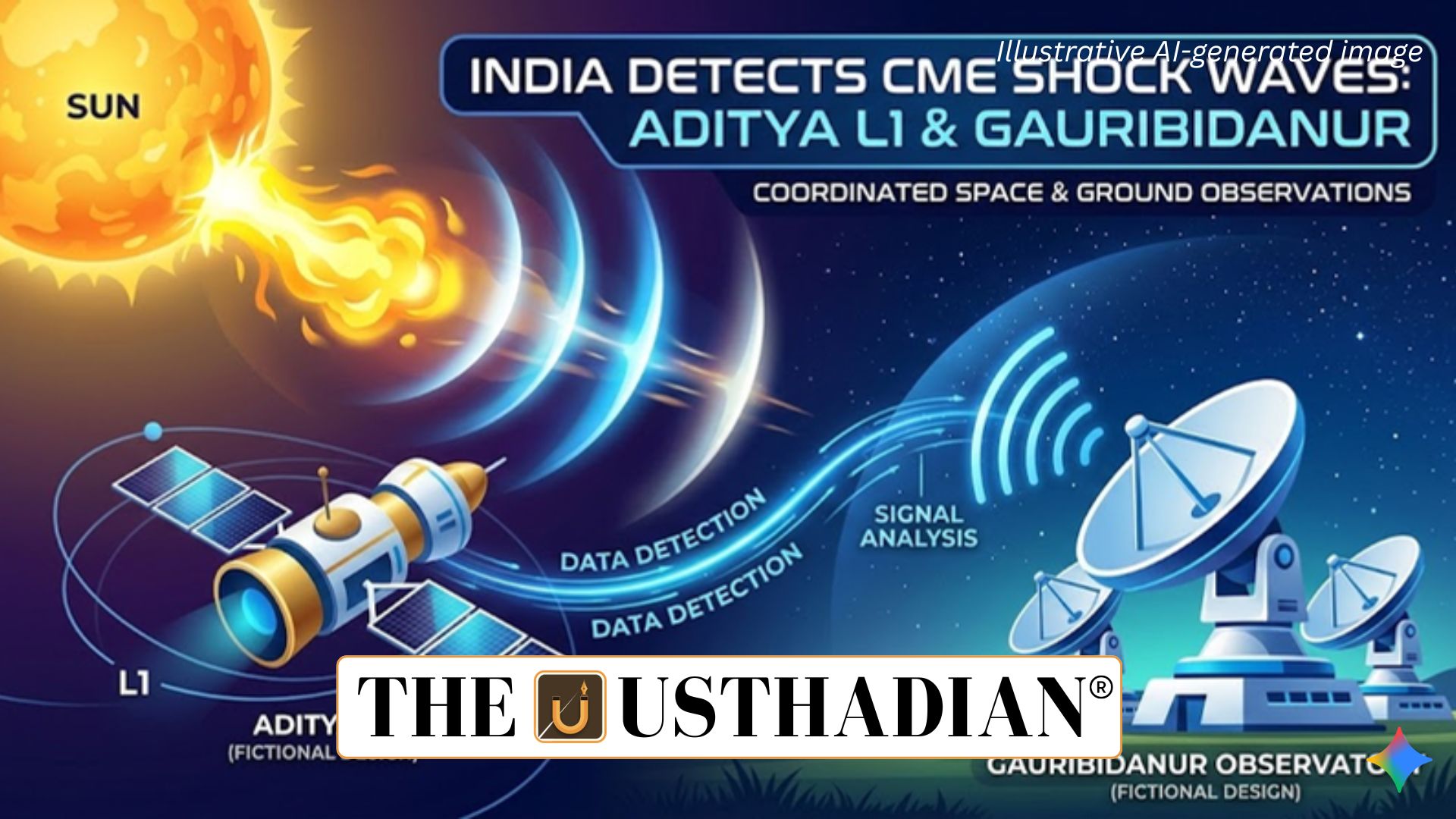
India Detects CME Shock Waves Using Aditya L1 and Gauribidanur: Indian scientists have successfully observed shock waves triggered by Coronal Mass Ejection (CME). The discovery was made using the Gauribidanur Radio Telescope operated by the Indian Institute of Astrophysics, along with the Visible Emission Line Coronagraph (VELC) onboard Aditya L1.
This marks a significant milestone in India’s growing capability in space weather monitoring. Gauribidanur remains India’s only dedicated low-frequency solar radio observatory, making it strategically important for solar research.
Static GK fact: The Indian Institute of Astrophysics (IIA) functions under the Department of Science and Technology and is headquartered in Bengaluru.
What is Coronal Mass Ejection
A Coronal Mass Ejection (CME) is a massive burst of solar plasma, charged particles, and magnetic fields ejected from the Sun’s outer atmosphere, known as the corona. These eruptions release enormous energy into interplanetary space.
When a CME travels at very high speed, it generates shock waves. These shock waves can disturb the Earth’s magnetic shield, known as the magnetosphere, leading to geomagnetic storms.
Static GK Tip: The corona is the outermost layer of the Sun and is visible during a total solar eclipse.
Impact on Earth
Fast-moving CMEs can compress Earth’s magnetosphere. This results in geomagnetic storms that may disrupt satellites, GPS navigation, radio communication systems, and power grids.
They can also intensify auroras near the polar regions. Increased radiation levels pose risks for astronauts and high-altitude aviation routes.
CMEs are most frequent during the solar maximum phase of the Sun’s approximately 11-year sunspot cycle. They are often associated with solar flares, though they can occur independently.
Role of Aditya L1
Aditya L1 is India’s first dedicated solar mission launched in 2023 by PSLV-C57. It carries seven indigenously developed payloads designed to study the Sun’s photosphere, chromosphere, and corona.
The spacecraft is positioned in a halo orbit around Lagrange Point L1, approximately 1.5 million km from Earth. This location allows continuous and uninterrupted observation of the Sun.
The VELC payload onboard Aditya L1 plays a crucial role in observing the corona and detecting CME-related structures.
Static GK fact: Lagrange Points are positions in space where the gravitational forces of two large bodies balance each other. There are five such points in the Sun–Earth system.
Importance for Space Weather Research
Monitoring CME-driven shock waves is essential for improving space weather forecasting models. Early detection allows better preparedness against potential disruptions to communication and power infrastructure.
India’s independent capability in observing solar shock waves strengthens its strategic space research profile. It also enhances global understanding of solar-terrestrial interactions.
Static Usthadian Current Affairs Table
India Detects CME Shock Waves Using Aditya L1 and Gauribidanur:
| Topic | Detail |
| Event | Indian scientists observed shock waves from CME |
| Instruments Used | Gauribidanur Radio Telescope and VELC |
| Mission Involved | Aditya L1 |
| Launch Year | 2023 |
| Launch Vehicle | PSLV-C57 |
| Location of Mission | Halo orbit around L1 (1.5 million km from Earth) |
| CME Occurrence | Common during solar maximum phase |
| Impact on Earth | Geomagnetic storms, satellite and GPS disruption |