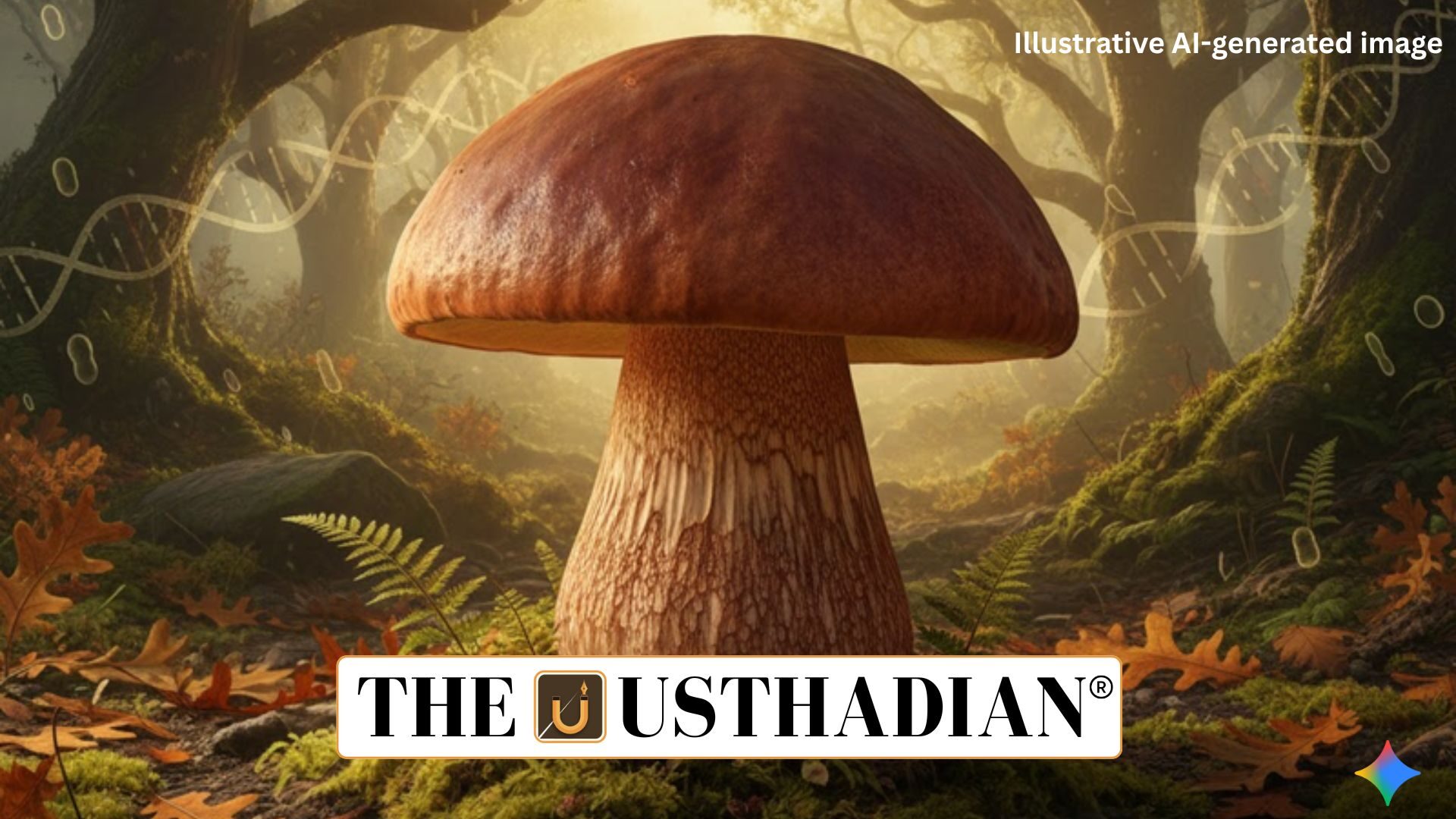
Discovery of a New Mushroom Species
Hemileccinum indicum Discovery in Himalayan Oak Forests: Scientists have identified a new mushroom species named Hemileccinum indicum in the Himalayan oak forests of Uttarakhand. This discovery marks the first official record of the genus Hemileccinum in India, making it a major milestone in Indian fungal taxonomy.
The species was documented during field surveys conducted in 2022–23. It highlights the rich but underexplored fungal biodiversity of the Indian Himalayas.
Location and Field Exploration
The mushroom was discovered in the Dhakuri region of Bageshwar district, located at an altitude of over 2,600 metres in the Central Himalayas. The area is dominated by oak forests, especially trees of the Quercus genus.
The discovery took place during macrofungal forays, which are systematic monsoon-season field studies focused on large fungi. These surveys were conducted by researchers from the Botanical Survey of India, the University of Torino, and St. Xavier’s College.
Static GK fact: Uttarakhand lies in the Central Himalayan biogeographic zone, one of India’s most biodiversity-rich ecological regions.
Scientific Identification and Classification
Initial observations showed similarities with mushroom species found in North America and China. However, advanced laboratory analysis confirmed that it was genetically distinct.
Scientists used multigene molecular phylogenetic analysis to compare its DNA with global fungal databases. The results showed close relation to a species from Florida, but with a unique genetic structure, confirming it as a new species.
This discovery significantly expands the global range of the Hemileccinum genus. It also adds a new branch to the fungal evolutionary tree.
Physical and Microscopic Features
Hemileccinum indicum belongs to the boletes group, which have pores instead of gills under their caps. Its cap is violet-brown and wrinkled, turning leathery brown as it matures.
The pore surface is pastel yellow and does not change colour when bruised. The stem is smooth, unlike related species that usually have scaly stems.
Its most distinctive feature appears under a Scanning Electron Microscope. The spores show tiny pitted structures, a rare microscopic trait that clearly separates it from similar species.
Static GK Tip: Boletes are ecologically important fungi known for forming strong forest symbiotic relationships.
Ecological Significance
The mushroom is ectomycorrhizal, meaning it forms a mutually beneficial relationship with tree roots. It partners specifically with Quercus (oak) species.
This relationship helps trees absorb nutrients and water, while the fungus receives sugars and organic carbon. Such interactions strengthen soil stability, forest health, and nutrient cycling.
This discovery highlights the invisible ecological services of fungi in Himalayan ecosystems. Fungi act as natural nutrient recyclers and ecosystem stabilisers.
Importance for India’s Biodiversity Conservation
India’s fungal diversity is largely undocumented, especially in high-altitude temperate forests. Discoveries like Hemileccinum indicum indicate that many species remain scientifically unknown.
Fungi play a key role in climate resilience, soil fertility, carbon cycling, and ecosystem balance. They are also critical for future pharmaceutical and biotechnological research.
Protecting forest habitats is essential not only for visible wildlife, but also for microscopic biodiversity that sustains ecosystems. This discovery strengthens the case for conservation-driven research in Himalayan forest regions.
Static Usthadian Current Affairs Table
Hemileccinum indicum Discovery in Himalayan Oak Forests:
| Topic | Detail |
| New species name | Hemileccinum indicum |
| Discovery region | Dhakuri, Bageshwar district, Uttarakhand |
| Altitude | Above 2,600 metres |
| Forest type | Himalayan oak forests |
| Tree association | Quercus species |
| Fungal type | Ectomycorrhizal fungus |
| Scientific method used | Multigene molecular phylogenetic analysis |
| Genus record | First Hemileccinum record in India |
| Ecological role | Nutrient cycling and forest health |
| Biodiversity significance | Expansion of India’s fungal taxonomy |