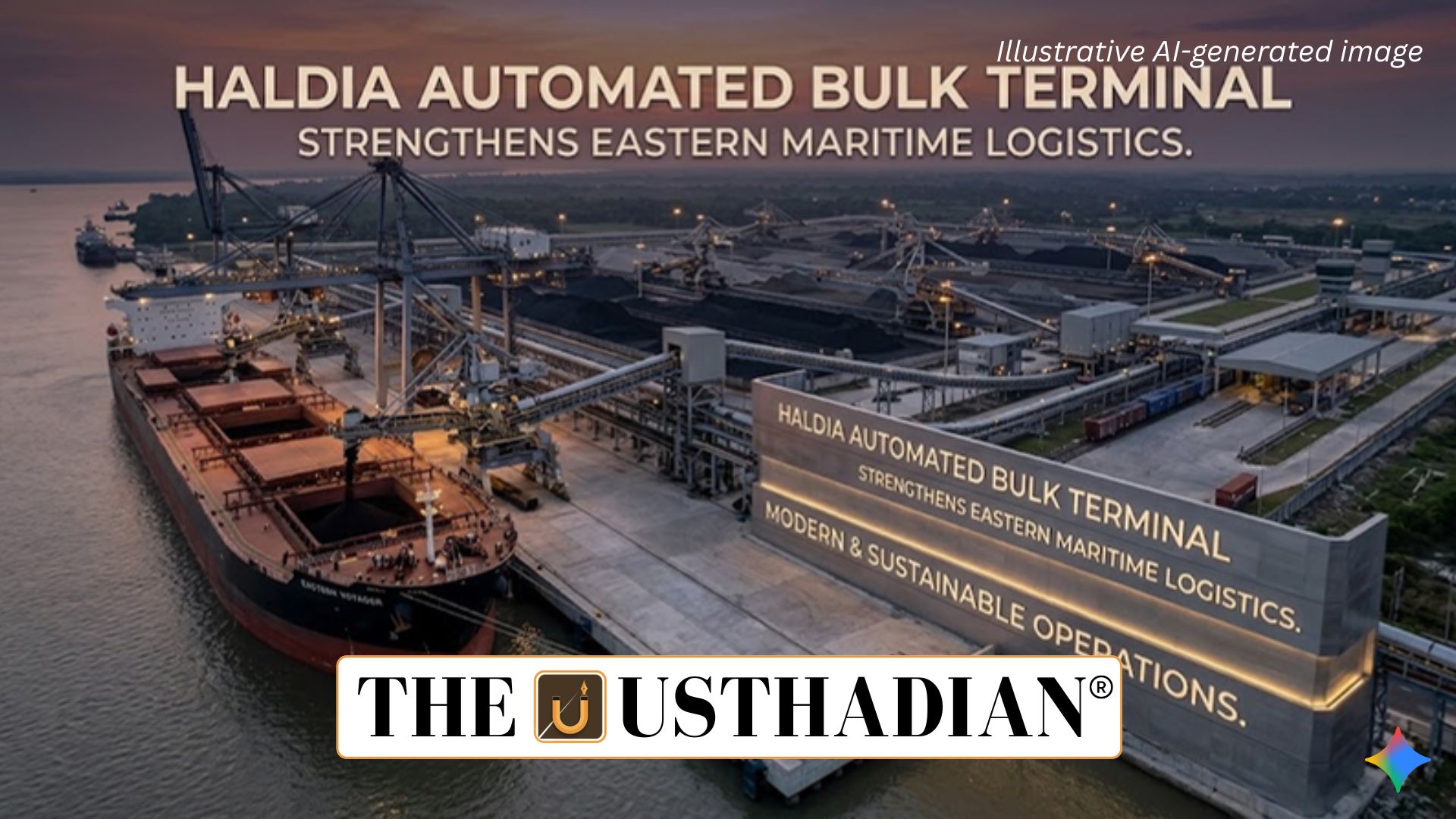
Launch of a major maritime infrastructure project
Haldia Automated Bulk Terminal Strengthens Eastern Maritime Logistics: Prime Minister Narendra Modi inaugurated the fully automated Haldia Bulk Terminal at the Haldia Dock Complex of Syama Prasad Mookerjee Port, Kolkata. The facility has been developed by Adani Ports and Special Economic Zone Limited (APSEZ) and represents a major step in modernising India’s eastern maritime infrastructure.
The project strengthens cargo handling capacity on the Hooghly River, an important maritime route in eastern India. The new terminal is expected to improve operational efficiency, reduce cargo losses and accelerate industrial supply chains across the region.
Static GK fact: Syama Prasad Mookerjee Port, Kolkata is the only major riverine port in India and operates through the Kolkata Dock System and Haldia Dock Complex.
India’s first automated dry bulk terminal on Hooghly
The Haldia Bulk Terminal has an annual cargo handling capacity of 4 million metric tonnes (MMTPA). It is recognised as India’s first fully automated dry bulk cargo facility on the Hooghly River.
The terminal is designed primarily to handle coal and other bulk commodities used by industries such as power generation, steel production and aluminium manufacturing. Efficient bulk handling is crucial because these industries rely heavily on timely supply of raw materials.
Located on the western bank of the Hooghly River, the facility enhances cargo movement across the eastern maritime corridor. It also strengthens port connectivity for industrial states such as West Bengal, Odisha and Jharkhand.
Static GK Tip: Haldia is an important industrial and petrochemical hub in West Bengal and serves as a key maritime gateway for eastern India.
Development under the DBFOT model
The terminal was developed through the Design, Build, Finance, Operate and Transfer (DBFOT) model under a 30-year concession agreement. The project was executed by HDC Bulk Terminal Ltd, a subsidiary involved in port infrastructure operations.
Construction began on July 14, 2023, and the project has been completed within the planned timeline. The terminal has a draft depth of 8.5 metres and a berth length of 193 metres, while the extreme mooring points extend to 337 metres.
This infrastructure enables the port to handle larger bulk cargo vessels efficiently and improves the speed of cargo loading and unloading operations.
Static GK fact: The DBFOT model is commonly used in public–private partnership (PPP) infrastructure projects in India, especially in ports, highways and airports.
Advanced mechanised cargo handling systems
The terminal is equipped with state-of-the-art mechanised cargo systems that enhance efficiency and minimise cargo loss. Key facilities include two mobile harbour cranes, two stacker-cum-reclaimers, and a 2,000-tonne railway wagon loading system.
A 2.10-kilometre conveyor belt system enables smooth cargo movement inside the port area. Additionally, a 1.54-kilometre dedicated railway line connects the terminal directly to the rail network.
These systems allow direct transfer of cargo from ships to railway wagons, significantly reducing port dwell time and improving cargo evacuation. As a result, industries across eastern India can receive raw materials faster and at lower logistics costs.
Role in strengthening eastern maritime trade
India’s east coast handles nearly 60 percent of the country’s dry bulk imports, including coal, bauxite and limestone. Ports in this region therefore play a vital role in supporting industrial growth.
The automated Haldia Bulk Terminal improves cargo handling speed and reduces ship turnaround time. It also promotes cleaner and safer port operations by limiting manual handling and minimising cargo spillage.
With this facility, the Haldia Dock Complex is expected to emerge as a stronger logistics hub supporting energy, steel and manufacturing industries across eastern India.
Static Usthadian Current Affairs Table
Haldia Automated Bulk Terminal Strengthens Eastern Maritime Logistics:
| Topic | Detail |
| Project | Haldia Bulk Terminal |
| Location | Haldia Dock Complex, Syama Prasad Mookerjee Port, Kolkata |
| Inaugurated by | Narendra Modi |
| Developer | Adani Ports and Special Economic Zone Limited |
| Cargo Capacity | 4 million metric tonnes annually |
| Key Feature | First fully automated dry bulk terminal on Hooghly River |
| Development Model | Design, Build, Finance, Operate and Transfer (DBFOT) |
| Major Infrastructure | Conveyor system, railway line, harbour cranes |
| Industrial Support | Coal and bulk commodities for power, steel and aluminium industries |
| Regional Impact | Strengthens eastern maritime logistics and industrial supply chains |