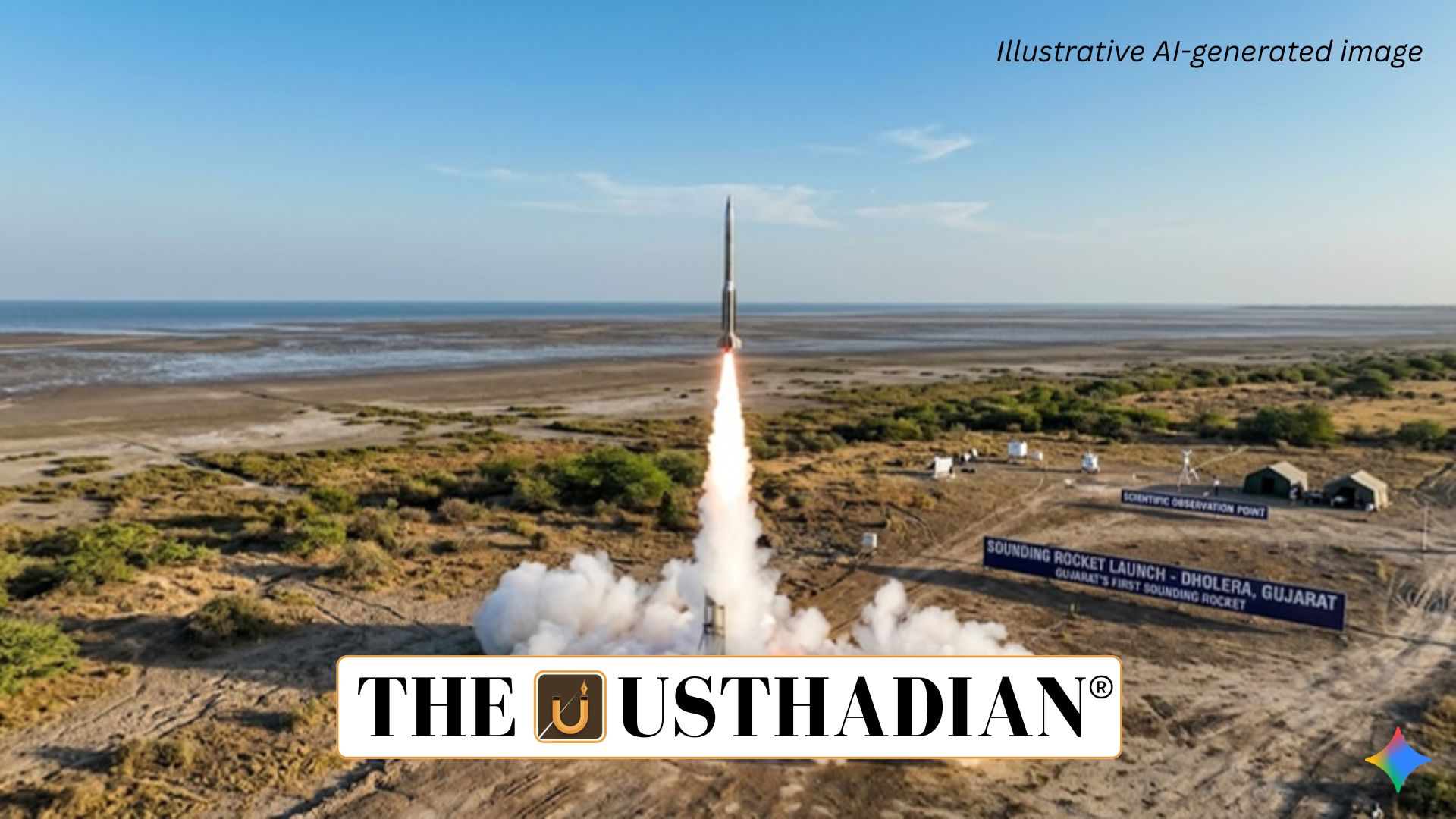
Historic Rocket Test in Gujarat
Gujarat’s First Sounding Rocket Launch Near Dholera: Gujarat entered India’s emerging private space ecosystem after the successful launch of its first sounding rocket on March 15, 2026. The launch took place near Bavliyari village close to Dholera, marking an important milestone in the state’s technological development.
The rocket was developed by Omspace Rocket and Exploration Pvt Ltd, a space technology startup based in Ahmedabad. The mission was conducted around 1 PM from a temporary launch facility in the presence of Arjun Modhwadia, Gujarat’s Minister for Science and Technology.
This successful launch highlights the growing role of Indian private startups in space technology development.
Static GK fact: India launched its first sounding rocket Nike-Apache from Thumba Equatorial Rocket Launching Station (TERLS) in 1963, marking the beginning of the country’s space research journey.
Mission Objectives and Flight Performance
The single-stage sub-orbital sounding rocket was designed primarily to test several advanced aerospace technologies. During the mission, the rocket successfully reached an altitude of approximately 3 kilometres before completing its planned flight sequence.
Officials confirmed that the rocket achieved its primary technical objectives, proving the capability of Indian startups to design and launch small experimental rockets domestically.
Sounding rockets are commonly used for scientific research, atmospheric studies, and technology validation because they are comparatively inexpensive and quicker to deploy than orbital rockets.
Key Systems Tested in the Rocket
The mission tested several crucial components required for future aerospace and launch vehicle development.
Among the most important systems tested were advanced propulsion technology, avionics and onboard control systems, and an autonomous recovery mechanism. These systems are essential for ensuring stability, navigation, and safe recovery during rocket missions.
Successful validation of these technologies strengthens the technical capability of India’s private space companies.
Static GK Tip: Avionics refers to the electronic systems used in aerospace vehicles, including navigation, communication, and flight control instruments.
Mini Satellite Payload for Weather Data
One of the significant features of the launch was the integration of a mini satellite payload designed to collect atmospheric and weather-related data during the mission.
Such payloads allow scientists to study temperature, pressure, wind patterns, and environmental conditions at various altitudes. Sounding rockets are particularly useful for these experiments because they can quickly reach the upper atmosphere.
The successful deployment of this payload demonstrated the potential of sounding rockets for scientific research and atmospheric monitoring.
Advanced Materials and Indigenous Development
The rocket’s airframe was constructed using carbon fibre and advanced composite materials, developed at the company’s Ahmedabad laboratory. According to Ravindra Raj, Founder and CEO of Omspace, these materials were produced under the Make in India initiative.
Composite materials reduce the overall weight of rockets while maintaining high structural strength, improving efficiency and performance. This achievement highlights India’s growing expertise in indigenous aerospace manufacturing.
Regulatory Support and Space Policy
The launch was conducted with approvals and technical coordination from multiple national agencies. These included the Airports Authority of India, Directorate General of Civil Aviation (DGCA), and the Indian Coast Guard to ensure safety and regulatory compliance.
Most importantly, the mission was authorized by Indian National Space Promotion and Authorisation Centre (IN-SPACe), the regulatory body that facilitates private sector participation in India’s space activities.
The project also aligns with the Gujarat Spacetech Policy 2025–2030, which aims to encourage space startups, satellite innovation, and aerospace research within the state.
Static GK fact: IN-SPACe was established in 2020 to regulate and promote private sector participation in India’s space sector alongside ISRO.
Static Usthadian Current Affairs Table
Gujarat’s First Sounding Rocket Launch Near Dholera:
| Topic | Detail |
| Event | Gujarat’s first sounding rocket launch |
| Date | March 15, 2026 |
| Launch Location | Bavliyari village near Dholera, Gujarat |
| Rocket Developer | Omspace Rocket and Exploration Pvt Ltd |
| Rocket Type | Single-stage sub-orbital sounding rocket |
| Maximum Altitude | Approximately 3 kilometres |
| Payload | Mini satellite for atmospheric and weather data |
| Materials Used | Carbon fibre and advanced composite materials |
| Regulatory Authority | IN-SPACe with coordination from DGCA, AAI and Indian Coast Guard |
| Policy Support | Gujarat Spacetech Policy 2025–2030 |