Strategic Infrastructure Milestone
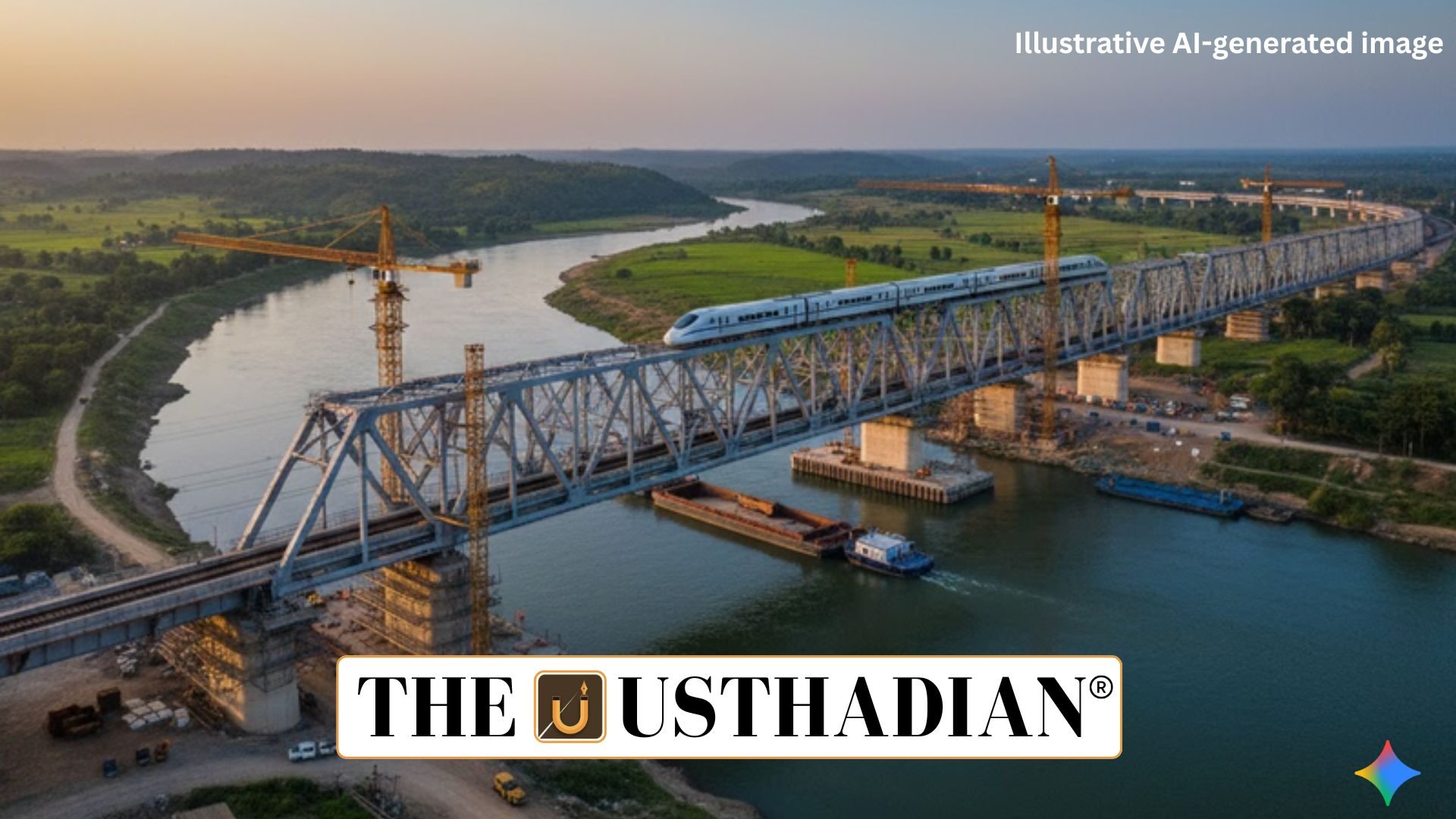
Engineering a 100-Metre Steel Bridge for India’s Bullet Train Corridor: India achieved a major engineering breakthrough on January 29, 2026, with the completion of a 100-metre-long steel bridge in Ahmedabad for the Mumbai-Ahmedabad Bullet Train Project.
The bridge is entirely manufactured under the Make in India initiative, reflecting India’s growing self-reliance in advanced infrastructure technologies.
What makes this project unique is that the bridge has been constructed above an underground metro tunnel without transferring any structural load onto it.
This solution demonstrates precision engineering, safety planning, and modern urban construction capability.
Urban Alignment Challenge
The bullet train alignment in Ahmedabad passes above the underground metro tunnel located between Kalupur and Shahpur stations.
Conventional viaduct structures usually use 30–50 metre concrete spans, supported by foundations placed close to the alignment.
However, placing foundations near the metro tunnel posed a serious risk of structural stress and vibration damage.
To eliminate this risk, engineers redesigned the alignment to create a single long span of 100 metres, ensuring zero load transfer to the tunnel below.
Static GK fact: Long-span bridge design is commonly used in dense urban zones to avoid underground utility damage and foundation interference.
Design Transformation Strategy
The structure was redesigned from a standard concrete viaduct into a steel truss bridge. Steel truss systems are ideal for long spans because they combine high load-bearing capacity with reduced foundation dependency.
This design ensures complete structural separation between the high-speed rail corridor and the metro rail system. It also highlights adaptive planning, where engineering design responds to urban constraints instead of rigid infrastructure models.
Advanced Assembly Technique
The bridge was assembled at a height of 16.5 metres using temporary trestle supports. Once the full steel structure was assembled, the trestles were carefully dismantled. The bridge was then lowered and placed precisely onto permanent supports using controlled engineering techniques. This process required high-precision alignment and load management to avoid any disturbance to metro or railway operations.
The entire operation was completed without disrupting active transport services, demonstrating India’s capacity for complex construction in congested city zones.
Static GK Tip: Steel truss bridges are widely used in high-speed rail corridors globally due to vibration resistance and load distribution efficiency.
Role in India’s High-Speed Rail Vision
The Mumbai-Ahmedabad Bullet Train Project is India’s first high-speed rail corridor, implemented by the National High Speed Rail Corporation Limited (NHSRCL). The corridor aims to reduce travel time between Mumbai and Ahmedabad to around two hours, transforming intercity mobility.
This bridge project reflects three national priorities: indigenous manufacturing, urban infrastructure integration, and high-speed transport modernisation. It also represents a shift towards engineering-led governance, where safety, planning, and sustainability guide infrastructure decisions.
National Significance
The bridge is not just a structural achievement but a symbol of India’s evolving engineering capacity. It integrates Make in India manufacturing, urban safety planning, and high-speed rail technology into one project.
Such projects strengthen India’s position in global infrastructure capability, showing readiness for complex, multi-layered urban transport systems.
Static Usthadian Current Affairs Table
Engineering a 100-Metre Steel Bridge for India’s Bullet Train Corridor:
| Topic | Detail |
| Project name | Mumbai-Ahmedabad Bullet Train Project |
| Implementing agency | National High Speed Rail Corporation Limited |
| Bridge length | 100 metres |
| Location | Ahmedabad district |
| Special feature | Built over underground metro tunnel |
| Design type | Steel truss bridge |
| Assembly height | 16.5 metres |
| Manufacturing model | Make in India |
| Engineering method | Long-span load-free foundation design |
| National objective | High-speed rail infrastructure development |