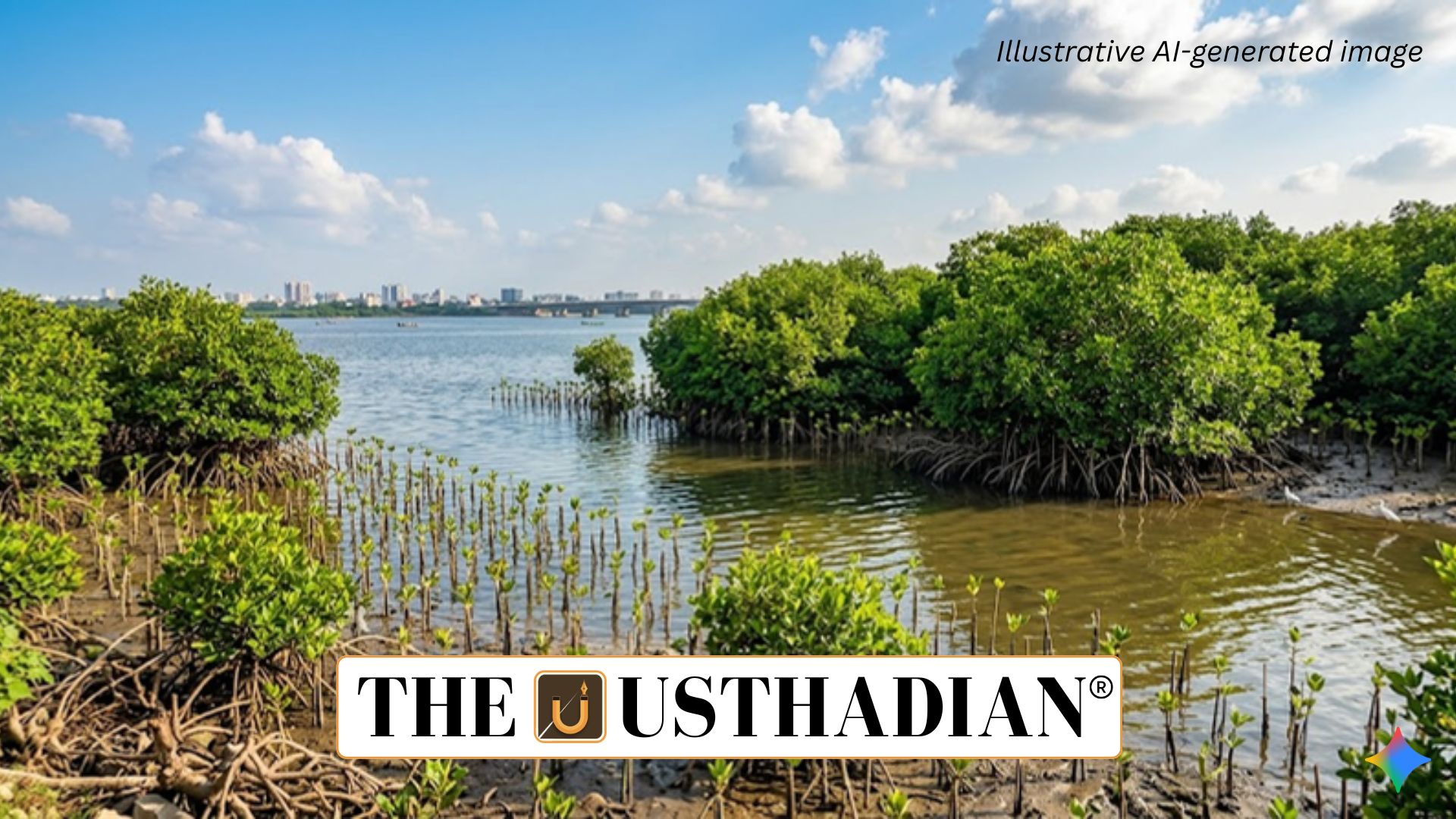
Restoration drive in Chennai
Chennai Mangrove Restoration Initiative: The Tamil Nadu Forest Department has initiated a large-scale mangrove restoration programme in Chennai. Around 20,000 mangrove seedlings were planted along the Buckingham Canal to strengthen the coastal ecosystem.
This effort aims to improve climate resilience and reduce the impact of coastal hazards. Mangroves act as natural buffers against cyclones and flooding.
Static GK fact: The Buckingham Canal is a historic navigation canal running parallel to the Coromandel Coast.
Phased mangrove plantation plan
The restoration is being implemented in a phased manner to gradually build a strong green belt. During 2024–25, about 12,500 seedlings of six mangrove species were planted across 20 hectares.
The species include Rhizophora mucronata, Bruguiera cylindrica, Avicennia marina, Aegiceras corniculatum, Excoecaria agallocha, and Acanthus ilicifolius. These species are selected for their adaptability to saline environments.
Expansion at Adyar estuary
In the second phase, nearly 5,000 mangrove saplings were planted at the Battle of Adyar Island in the Adyar River estuary. The species included Rhizophora mucronata, Rhizophora apiculata, Avicennia marina, and Excoecaria agallocha.
The estuarine ecosystem is crucial for maintaining ecological balance and supporting aquatic life. Mangroves help stabilize sediments and improve water quality.
Static GK Tip: Estuaries are regions where freshwater meets seawater, creating nutrient-rich ecosystems.
Latest phase of plantation
The latest phase involves planting 20,000 seedlings of five key species such as Avicennia marina, Avicennia officinalis, Rhizophora mucronata, Rhizophora apiculata, and Excoecaria agallocha.
This step strengthens the continuity of mangrove cover along Chennai’s coastline. The focus remains on creating a dense and sustainable mangrove ecosystem.
Ecological and strategic significance
Mangroves serve as a living coastal bioshield by reducing wave energy and preventing shoreline erosion. They also support biodiversity, including fish, birds, and crustaceans.
The initiative helps Chennai adapt to sea-level rise and extreme weather events. It aligns with broader climate adaptation strategies in coastal cities.
Static GK fact: Mangroves can store three to five times more carbon than terrestrial forests, making them vital for carbon sequestration.
Way forward
Sustained monitoring and community participation are essential for the success of this initiative. Scientific management and periodic assessment will ensure long-term survival of plantations.
Expanding such restoration projects can make Chennai a model for urban coastal conservation in India.
Static Usthadian Current Affairs Table
Chennai Mangrove Restoration Initiative:
| Topic | Detail |
| Project location | Buckingham Canal and Adyar estuary |
| Implementing agency | Tamil Nadu Forest Department |
| Total seedlings | 20,000 in latest phase |
| Earlier plantation | 12,500 seedlings across 20 hectares |
| Second phase | 5,000 saplings at Adyar estuary |
| Key species | Rhizophora, Avicennia, Excoecaria |
| Objective | Coastal protection and biodiversity |
| Significance | Climate resilience and erosion control |