Location and discovery
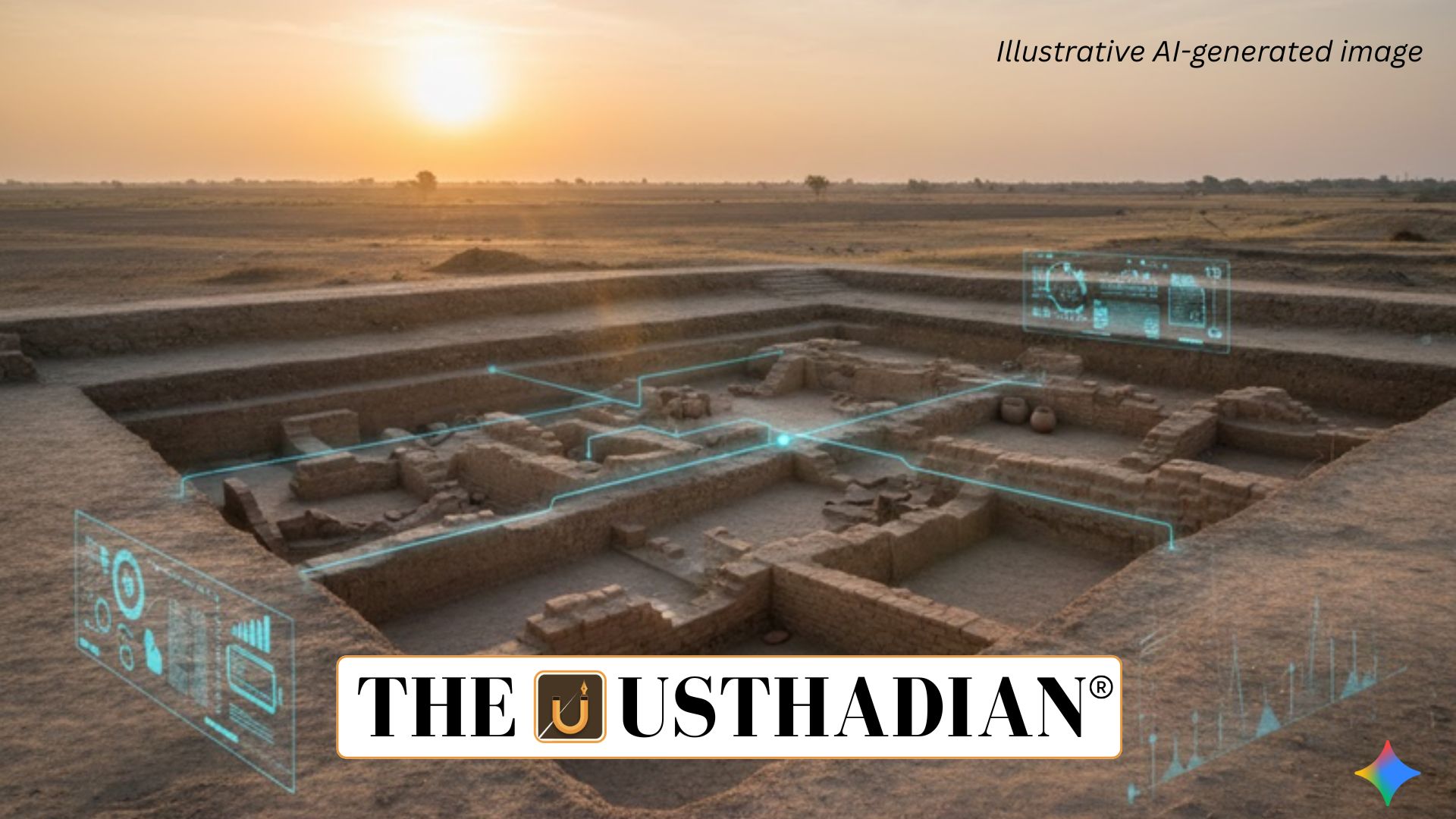
Bhirrana and the Deep Antiquity of Harappan Roots: The Bhirrana site, located in Fatehabad district of Haryana, is one of the most significant archaeological sites linked to the Harappan Civilisation. It lies along the paleo-channels of the ancient Ghaggar river, which is believed by many scholars to be associated with the lost Saraswati river system.
The site was excavated under the leadership of Shri L.S. Rao, an archaeologist from the Archaeological Survey of India (ASI). Excavations revealed continuous cultural layers, making Bhirrana one of the oldest Harappan settlements discovered in the Indian subcontinent.
Static GK fact: The Indus Valley Civilisation is one of the world’s four earliest civilisations, along with Mesopotamia, Egypt, and China.
Radiocarbon dating and historical importance
Recent Radiocarbon dating studies conducted at Bhirrana have revealed remarkable findings about the antiquity of the Harappan Civilisation. Scientific analysis indicates that human settlement at Bhirrana dates back to around 7500–8000 years ago, pushing the origin of Harappan culture much earlier than previously estimated.
This discovery challenges the earlier timeline, which placed the beginning of Harappan civilisation around 3300 BCE. It suggests that the roots of urban development, agriculture, and organised settlements in India emerged much earlier.
Static GK Tip: Radiocarbon dating is a scientific method used to determine the age of organic materials by measuring the decay of Carbon-14 isotope.
Cultural phases at Bhirrana
Archaeologists have identified multiple cultural phases at Bhirrana, showing gradual development from early rural settlement to a mature urban civilisation.
Hakra Ware culture phase
The earliest phase, known as Period-IA or Hakra Ware culture, is characterised by subterranean dwelling pits dug into natural soil. These pits were well plastered and indicate early human adaptation to environmental conditions.
The ceramic assemblage of this phase shows primitive pottery, marking the initial stage of settlement formation. This phase is considered pre-Harappan and represents the foundation of later urban growth.
Early and Mature Harappan phases
During Period-IB or Early Harappan phase, houses were constructed using mud bricks, showing technological advancement. Pottery found here displayed six distinct fabrics, similar to those discovered at Kalibangan, another important Harappan site.
In Period-IIA or Early Mature Harappan phase, the settlement underwent significant transformation. The city was enclosed by a mud-brick fortification wall, indicating planned urban development and defence mechanisms.
By Period-IIB or Mature Harappan phase, the site displayed features typical of a fully developed Harappan city. Archaeologists discovered steatite seals, standardized pottery, and urban artefacts, which reflect administrative and economic organisation.
Static GK fact: Steatite seals were used by Harappans for trade, administration, and identification purposes.
Antiquities and material culture
The Bhirrana site yielded several important antiquities that reveal advanced craftsmanship. These include beads made of semi-precious stones, terracotta objects, copper bangles, and bone tools.
These artefacts show that the people of Bhirrana were skilled in metallurgy, jewellery making, and craft production. The presence of standardized artefacts also suggests trade networks and economic integration with other Harappan cities.
Significance for Indian civilisation
The discoveries at Bhirrana provide strong evidence that the Harappan Civilisation may be over 8,000 years old, making it one of the oldest continuous civilisations in the world. It also confirms that the Ghaggar-Hakra region was a major centre of early human settlement.
This site strengthens India’s position as one of the earliest cradles of urban civilisation and highlights the indigenous development of complex societies.
Static Usthadian Current Affairs Table
Bhirrana and the Deep Antiquity of Harappan Roots:
| Topic | Detail |
| Location | Fatehabad district, Haryana |
| Excavated by | Archaeologist L.S. Rao |
| River system | Paleo-channel of Ghaggar river |
| Dating method | Radiocarbon dating |
| Estimated age | Around 7500–8000 years |
| Earliest phase | Hakra Ware culture |
| Urban development | Mud-brick houses and fortification walls |
| Mature Harappan features | Steatite seals and standard artefacts |
| Important artefacts | Beads, terracotta objects, copper bangles |
| Civilisation relevance | One of the oldest Harappan settlements |