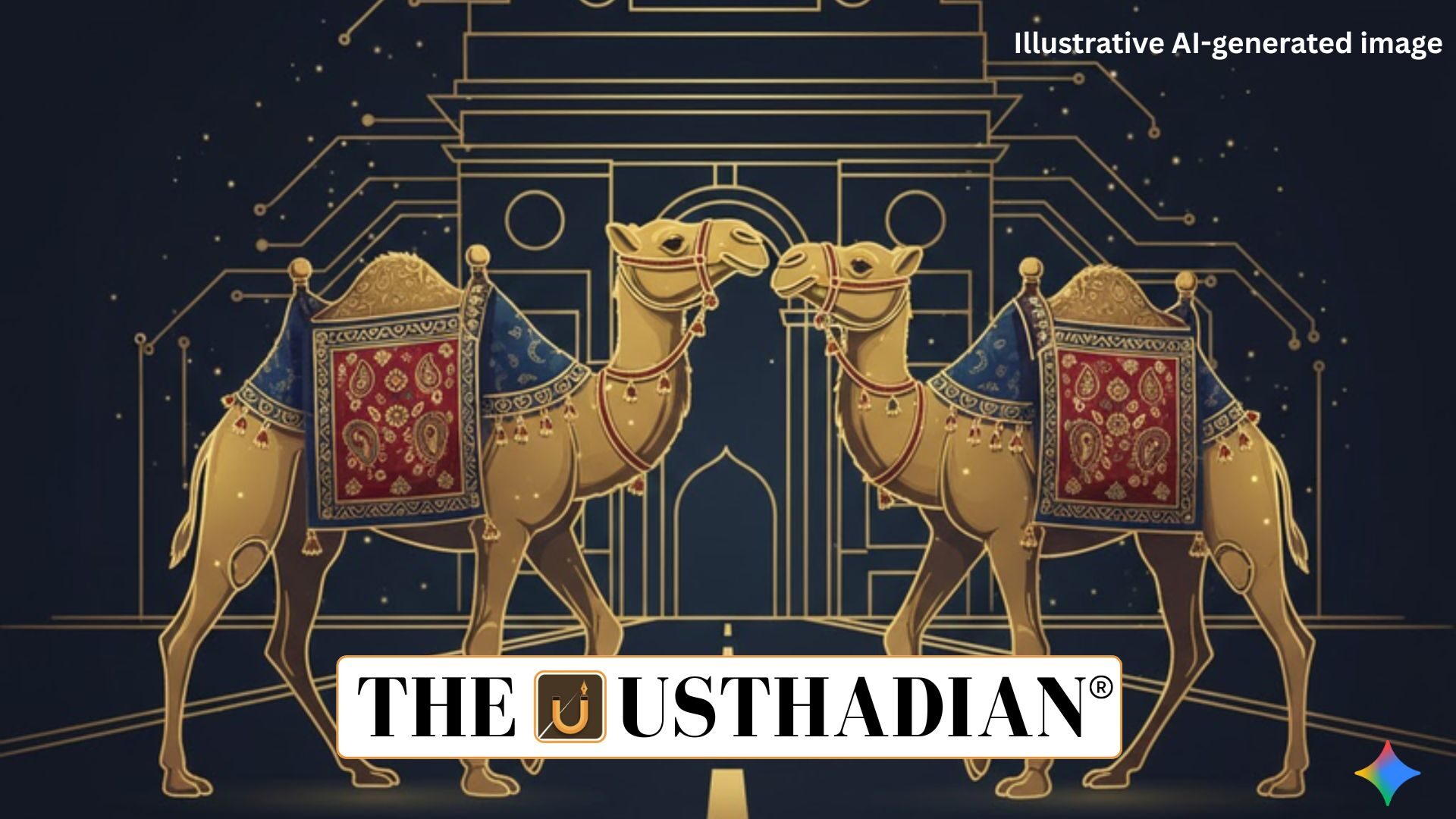
Historic debut on Kartavya Path
Bactrian Camels and India’s Historic Republic Day Moment: For the first time in India’s Republic Day history, double-humped Bactrian camels from Ladakh marched in the Republic Day Parade 2026 at Kartavya Path. This was not a ceremonial addition alone, but a powerful national statement on biodiversity, strategic resilience, and high-altitude preparedness.
Two camels named Galwan and Nubra symbolised India’s Himalayan ecological heritage and emerging defence logistics vision. Their presence marked a fusion of tradition, security, and environmental identity.
Rare species from India’s cold desert
Bactrian camels, locally called Mundri camels, are native to the cold desert ecosystem of Ladakh. They are found mainly in the Nubra Valley, one of India’s most extreme climatic regions.
India has only about 365 Bactrian camels, making them one of the rarest domesticated species in the country. Their limited population makes their national-level recognition historically significant.
Static GK fact: Ladakh is classified as a cold desert biome, unlike hot deserts like Thar, due to low precipitation and extreme winter temperatures.
Biological design for extreme altitudes
These camels are naturally engineered for survival in high-altitude terrain. They function efficiently at altitudes of 14,000–15,000 feet and temperatures falling below –30°C.
They can carry 150–170 kg loads and walk 10–12 km daily in low-oxygen zones. Their two humps store fat-based energy, allowing survival without food for two to three weeks.
They can even survive by consuming snow for hydration during winters. This makes them uniquely suited for terrain where machines and vehicles fail.
Static GK Tip: High-altitude adaptation in animals depends on oxygen efficiency, fat metabolism, and thermal insulation.
Defence trials and strategic value
Recognising their potential, trials were conducted by DIHAR under DRDO in extreme Himalayan conditions. Tests at 17,000 feet confirmed that Bactrian camels outperform mules and ponies in extreme cold terrain.
Standard operating procedures were developed for feeding, breeding, healthcare, and load management. They are now considered reliable for border logistics, especially in non-road, snowbound, and high-risk zones.
Unlike machines, these animals are silent, fuel-free, non-jammable, and weather-resilient. This gives them tactical value in sensitive border regions.
From Silk Route to border strategy
Historically, Bactrian camels were the backbone of the ancient Silk Route trade system. They transported silk, spices, tea, and metals across Central Asia, China, Mongolia, and India.
Their Republic Day appearance symbolised continuity from ancient trade networks to modern defence logistics. This reflects India’s strategy of combining traditional resilience with modern military planning.
Static GK fact: The Silk Route extended over 6,400 km, connecting Asia with Europe through land corridors.
National symbolism and strategic messaging
Their inclusion in the parade highlighted ecological conservation, strategic preparedness, and indigenous biological assets. It also projected India’s focus on high-altitude border security and sustainable defence systems.
The event transformed a rare species into a symbol of national resilience and geostrategic innovation.
Static Usthadian Current Affairs Table
Bactrian Camels and India’s Historic Republic Day Moment:
| Topic | Detail |
| Species | Bactrian camel (double-humped) |
| Local name | Mundri camel |
| First parade appearance | Republic Day 2026 |
| Native region | Nubra Valley, Ladakh |
| Estimated population in India | Around 365 |
| Load capacity | 150–170 kg |
| Operational altitude | 14,000–17,000 feet |
| Defence institution | DIHAR under DRDO |
| Strategic role | High-altitude border logistics |
| Historical link | Ancient Silk Route trade network |