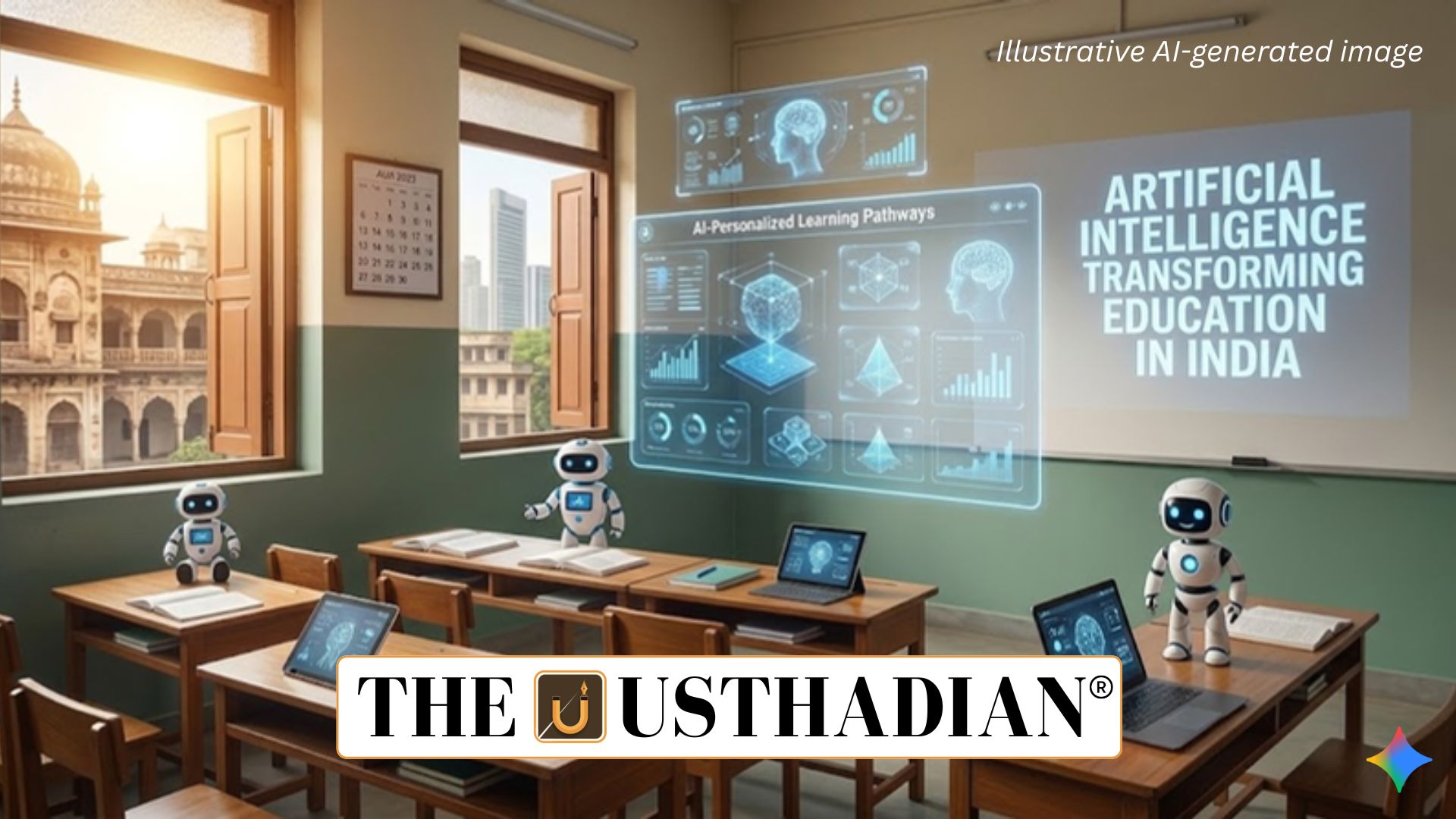
AI reshaping the education ecosystem
Artificial Intelligence Transforming Education in India: Artificial Intelligence (AI) is emerging as a powerful solution to address structural challenges in India’s education system, such as learning gaps, teacher shortages, and uneven access to quality resources. AI-driven tools enable data-based decision making, adaptive learning systems, and efficient governance mechanisms.
India’s push for digital education accelerated after NEP 2020, which emphasised the integration of AI, big data, and machine learning into teaching and learning processes. These technologies help modernise both classroom teaching and education administration.
Static GK fact: India has one of the world’s largest school systems, with over 250 million students enrolled in schools, making technology-based solutions essential for scale.
Personalised learning for students
One of the most important benefits of AI-based learning platforms is the creation of personalised learning paths. AI systems analyse a student’s performance in real time and adjust the difficulty level, pace, and learning format accordingly.
For example, platforms such as MindCraft provide customised content for rural students, ensuring that learning materials match their understanding level. This reduces dropout rates and improves conceptual clarity.
AI tools also support remedial learning, where weak areas of students are automatically identified and targeted through adaptive quizzes and practice modules.
Static GK Tip: The concept of adaptive learning technology uses algorithms to modify educational content based on individual performance.
AI assisting teachers and classrooms
AI technologies are not meant to replace teachers but to enhance teaching effectiveness. According to an NCERT study in 2024, teachers trained with AI-assisted lesson planning tools were able to better identify learning gaps and tailor their teaching strategies.
AI can automatically generate lesson plans, assessments, and classroom analytics, allowing teachers to focus more on mentoring students rather than administrative tasks.
These systems also analyse classroom performance trends, helping teachers identify slow learners and high-performing students early.
Smart assessments and feedback systems
Traditional examination systems mainly measure final performance, but AI allows continuous and formative assessments. AI-enabled evaluation tools can instantly analyse answers and provide real-time feedback to students.
Teachers receive data-driven insights on student performance, enabling them to modify teaching strategies quickly. Such systems help move the education system from memorisation-based learning to competency-based evaluation.
Static GK fact: India introduced Competency-Based Education under the National Curriculum Framework 2023, which emphasises skill-based assessment.
Governance and inclusive education
AI also strengthens education governance and monitoring systems. Using predictive analytics and AI-powered dashboards, administrators can track attendance, learning outcomes, and resource utilisation across schools.
AI-driven technologies also promote inclusive education. Assistive AI tools help students with visual, hearing, and learning disabilities through speech recognition, text-to-speech conversion, and adaptive interfaces.
Multilingual AI tools further support India’s linguistic diversity, enabling students to learn in their regional languages and dialects.
Static GK Tip: India recognises 22 scheduled languages under the Constitution, making multilingual digital learning tools highly important.
Government initiatives promoting AI education
The Indian government has launched several initiatives to expand AI education and digital learning infrastructure. NEP 2020 strongly advocates integrating emerging technologies in school and higher education.
At the school level, CBSE and NCERT have introduced AI-based curricula aligned with NCF 2023. Platforms such as DIKSHA and SOAR (Skilling for AI Readiness) aim to develop AI awareness among students of Classes 6–12 and teachers.
In higher education, the University Grants Commission (UGC) 2022 undergraduate curriculum includes subjects like machine learning, big data analytics, AI applications, and 3D machining.
Research and innovation are supported through initiatives like the National Research Foundation and the One Nation One Subscription programme, which improves access to global academic resources.
Static Usthadian Current Affairs Table
Artificial Intelligence Transforming Education in India:
| Topic | Detail |
| Technology in education | Artificial Intelligence enabling adaptive learning and analytics |
| Key policy | National Education Policy 2020 promoting AI integration |
| Curriculum reform | National Curriculum Framework 2023 encouraging competency-based learning |
| School initiatives | AI curriculum introduced by CBSE and NCERT |
| Digital learning platform | DIKSHA providing digital resources for students and teachers |
| Skill development programme | SOAR initiative promoting AI awareness among students |
| Online learning portal | SWAYAM offering AI courses from IITs and IISc |
| Higher education reform | UGC 2022 undergraduate curriculum including AI and big data |
| Research support | National Research Foundation encouraging innovation |
| Academic access | One Nation One Subscription expanding access to global journals |