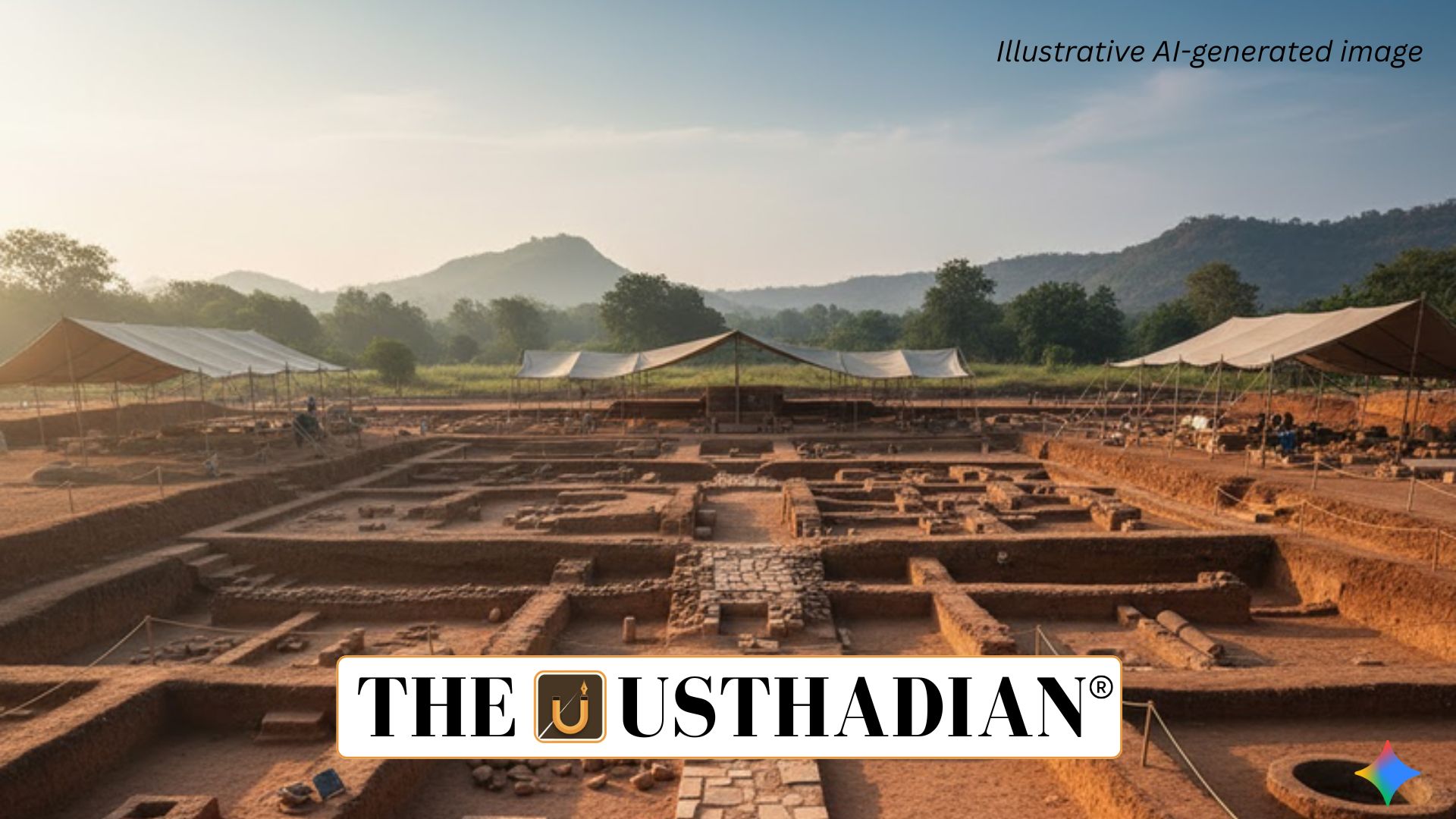
Keeladi reveals early urban civilisation
Archaeological Discoveries Reshaping Tamil Nadu Civilisation: The Keeladi excavation site in Sivagangai district has provided strong evidence of an advanced urban and industrial civilisation in Tamil Nadu. Scientific carbon dating places the artefacts between the 6th century BCE and 1st century CE, proving the antiquity of Tamil culture.
Excavations uncovered brick structures, drainage systems, ring wells, and dyeing vats, indicating planned urban settlements. The presence of Tamil-Brahmi inscriptions confirms literacy among inhabitants as early as the 6th century BCE, showing an organised society along the Vaigai river basin.
Static GK fact: Tamil-Brahmi is among the earliest scripts used to write the Tamil language, derived from the Brahmi script of ancient India.
The Tamil Nadu government established an open-air museum at Keeladi, displaying six thematic sections including ceramic industries, water management, trade, and lifestyle. This provides valuable insight into the Sangam age civilisation.
Museums preserving archaeological heritage
The Porunai Museum in Tirunelveli district exhibits artefacts from Adichanallur, Sivagalai, and Korkai, highlighting ancient Tamil culture. Discoveries such as Roman pottery, shipwreck remains, and lead ingots confirm maritime trade with Rome, China, and Southeast Asia.
Similarly, the Grand Chola Museum being constructed at Tamil University, Thanjavur, will showcase the achievements of the Chola dynasty, including their administrative strength and naval power. A major attraction will be a 125-foot statue of Raja Raja Chola I, one of India’s greatest emperors.
Static GK Tip: The Chola dynasty (9th–13th century CE) built one of the strongest naval forces in medieval India and expanded influence across Southeast Asia.
The museum at Gangaikonda Cholapuram, built by Rajendra Chola I, will preserve artefacts such as stone sculptures, inscriptions, and palace remains, highlighting imperial governance and diplomacy.
Evidence of maritime trade and global links
The ancient port of Alagankulam, located near the Vaigai river and Bay of Bengal, functioned as a major trade centre between the 2nd century BCE and 5th century CE. Archaeological finds include Roman amphorae, Arretine ware, and ship graffiti, proving extensive global trade.
The Naavai Museum, proposed at Mandapam, will display ship-related artefacts. The term Naavai means large ship in ancient Tamil, symbolising Tamil maritime strength.
Static GK fact: The Pandyas and Cholas were among the earliest Indian kingdoms to maintain organised naval forces and trade networks.
Industrial and cultural centres like Kodumanal
The archaeological site of Kodumanal, located on the Noyyal river, functioned as a major industrial centre between the 5th century BCE and 3rd century CE. Excavations revealed thousands of semi-precious stone beads, including beryl, carnelian, quartz, and lapis lazuli, indicating global trade connections.
The discovery of Tamil-Brahmi inscribed potsherds confirms literacy and organised production. Megalithic burials, iron weapons, and ornaments highlight social and cultural development.
The upcoming Noyyal Museum will preserve these findings and promote awareness of ancient industrial excellence.
Mamallapuram and hero stones reflect rich traditions
The port city of Mamallapuram, developed under the Pallavas (6th–9th century CE), served as an important maritime hub connecting Tamil Nadu with Southeast Asia.
The proposed Dharmapuri Museum will focus on hero stones, which commemorate warriors. These artefacts provide insights into ancient Tamil warfare, social values, and artistic traditions.
Static GK fact: Mamallapuram monuments are recognised as a UNESCO World Heritage Site, reflecting Pallava architectural brilliance.
Strengthening cultural identity through archaeology
Archaeological investigations across Tamil Nadu confirm that the region had urban settlements, literacy, industrial production, and global trade links over 2,000 years ago. These discoveries align with scholarly interpretations that Tamil civilisation evolved independently with strong cultural continuity.
The establishment of museums ensures preservation and promotes awareness of Tamil Nadu’s rich heritage. These findings reinforce Tamil Nadu’s position as one of the world’s oldest continuously inhabited cultural regions.
Static Usthadian Current Affairs Table
Archaeological Discoveries Reshaping Tamil Nadu Civilisation:
| Topic | Detail |
| Major excavation site | Keeladi in Sivagangai district |
| Civilisation period | 6th century BCE to 1st century CE |
| Important script discovered | Tamil-Brahmi inscriptions |
| Major port site | Alagankulam |
| Trade partners | Rome, China, Southeast Asia |
| Industrial centre | Kodumanal bead manufacturing site |
| Major museum | Porunai Museum in Tirunelveli |
| Chola heritage preservation | Grand Chola Museum in Thanjavur |
| Important port city | Mamallapuram under Pallavas |
| Naval power evidence | Chola maritime expansion |