India’s Emerging Human Spaceflight Ecosystem
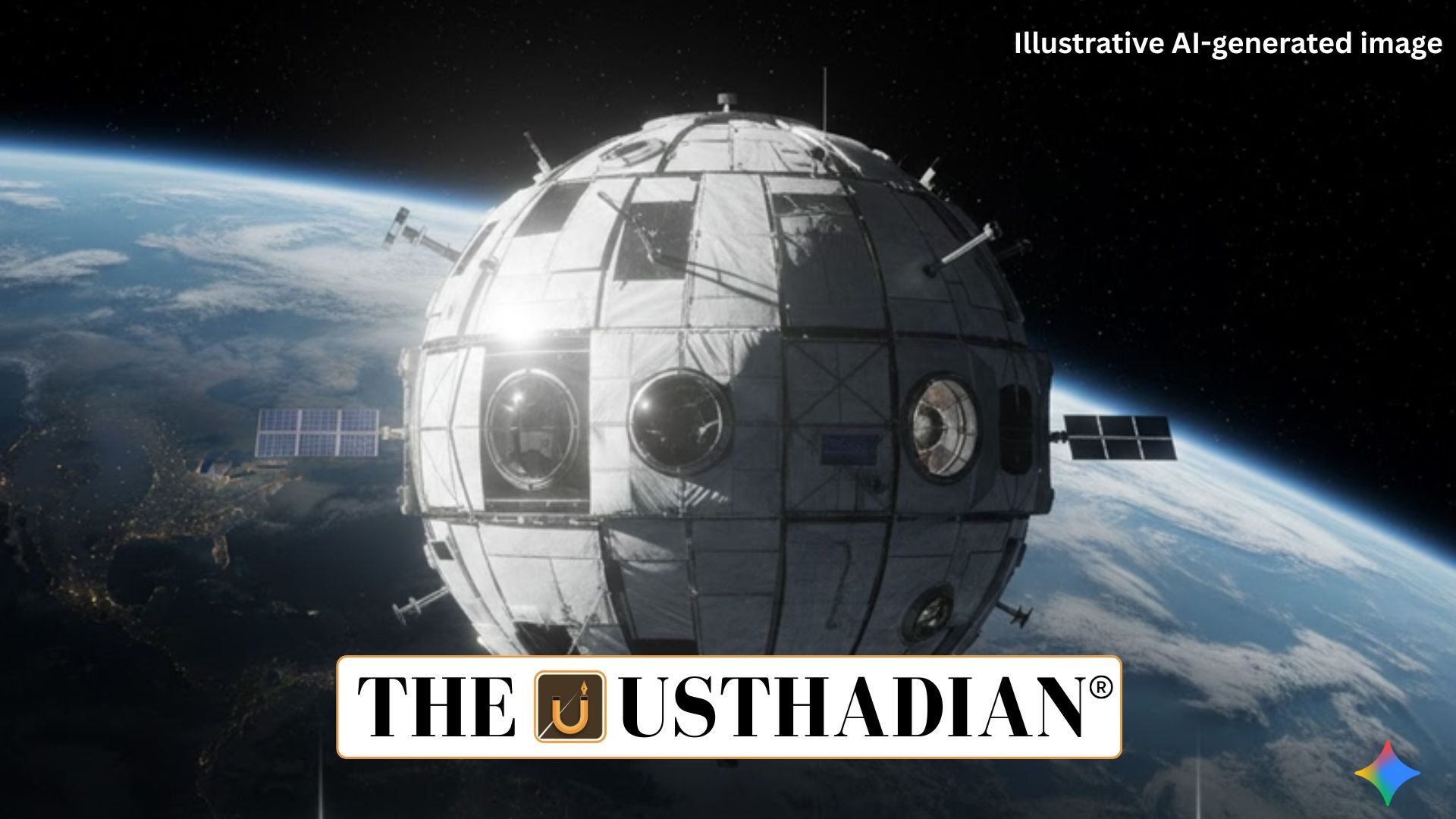
Akashlabdhi and India’s Inflatable Space Habitat Breakthrough: India is steadily expanding its capabilities in human spaceflight infrastructure. Alongside national programmes, private innovation is now shaping the future of orbital habitation. A Bengaluru-based startup, Akashlabdhi, incubated at Indian Institute of Science (IISc), has become a key symbol of this transformation.
The company is developing India’s first inflatable space habitat, marking a shift from traditional rigid space modules to flexible orbital infrastructure. This initiative strengthens India’s position in next-generation space habitation technologies.
Static GK fact: IISc Bengaluru, established in 1909, is one of India’s oldest scientific institutions and has contributed to major defence, space, and aerospace programmes.
AntarikshHAB Concept and Orbital Expansion
The inflatable habitat system is named AntarikshHAB. It follows a compact launch and in-orbit expansion model. This allows a small-volume payload at launch to transform into a large habitable structure after deployment.
The first orbital mission will deploy a 70 cubic metre module, while the final planned configuration aims for nearly 300 cubic metres of usable volume. This creates high volume-to-mass efficiency, which is a major limitation in conventional space station designs.
Inflatable habitats directly address issues of launch cost, payload mass, and habitable space limitations faced by rigid modules.
Static GK Tip: Traditional space stations like the International Space Station (ISS) rely on rigid aluminium pressure modules that are heavy and volume-restricted.
European Collaboration and Swiss Testing Ecosystem
The project is supported through European institutional collaboration, including partnerships linked to European Space Agency (ESA) programmes. Safety and validation testing was conducted at Versuchsstollen Hagerbach in Switzerland.
This underground laboratory enables realistic testing of radiation shielding, isolation environments, structural durability, and habitat integrity. Natural rock shielding creates conditions difficult to simulate in surface laboratories.
Swiss scientific institutions contribute expertise in materials science, radiation physics, and structural safety engineering, strengthening international technology exchange.
Static GK fact: Underground laboratories are globally used for radiation experiments, nuclear safety research, and deep-environment simulations.
Technology Readiness and Safety Validation
Akashlabdhi’s habitat system has reached Technology Readiness Level 6 (TRL-6). This indicates system validation in a relevant environment, a critical milestone before orbital deployment.
Testing included pressure integrity, leak-before-burst behaviour, thermal cycling, accelerated ageing, and micrometeoroid impact simulations. Multi-layer flexible structures were tested for resilience under space-like stress conditions.
Repeated deployment and inflation trials validated structural reliability. The system is supported by sensor networks and a digital twin framework for real-time performance tracking and predictive modelling.
Static GK fact: TRL levels range from 1 (basic concept) to 9 (flight-proven systems) and are globally used in aerospace technology assessment.
Orbital Demonstration and Sustainability Focus
The orbital mission will include a controlled de-orbit and atmospheric re-entry experiment. This will study material survivability, burn-up patterns, and debris mitigation behaviour.
This aligns with growing emphasis on low Earth orbit sustainability and space debris management. Controlled end-of-life disposal is now a core requirement in modern space mission design. The project also strengthens India–Europe cooperation in advanced space infrastructure development.
Static GK Tip: Space sustainability policies now prioritize controlled re-entry, orbital debris reduction, and responsible space operations.
India–Switzerland Space Research Linkages
Indian institutions such as IISc, IIT Roorkee, and IIT Delhi contribute expertise in space structures, materials engineering, and human-centric design. Swiss institutions provide support in radiation studies and validation systems.
This collaboration reflects India’s growing integration into global high-technology space ecosystems.
Static Usthadian Current Affairs Table
Akashlabdhi and India’s Inflatable Space Habitat Breakthrough:
| Topic | Detail |
| Startup | Akashlabdhi |
| Habitat system | AntarikshHAB |
| Core technology | Inflatable orbital habitat |
| First module size | 70 cubic metres |
| Final planned volume | Nearly 300 cubic metres |
| Incubation institute | IISc Bengaluru |
| Testing location | Versuchsstollen Hagerbach, Switzerland |
| Technology level | TRL-6 system validation |
| Orbit focus | Low Earth Orbit |
| Sustainability aspect | Controlled de-orbit and debris mitigation |