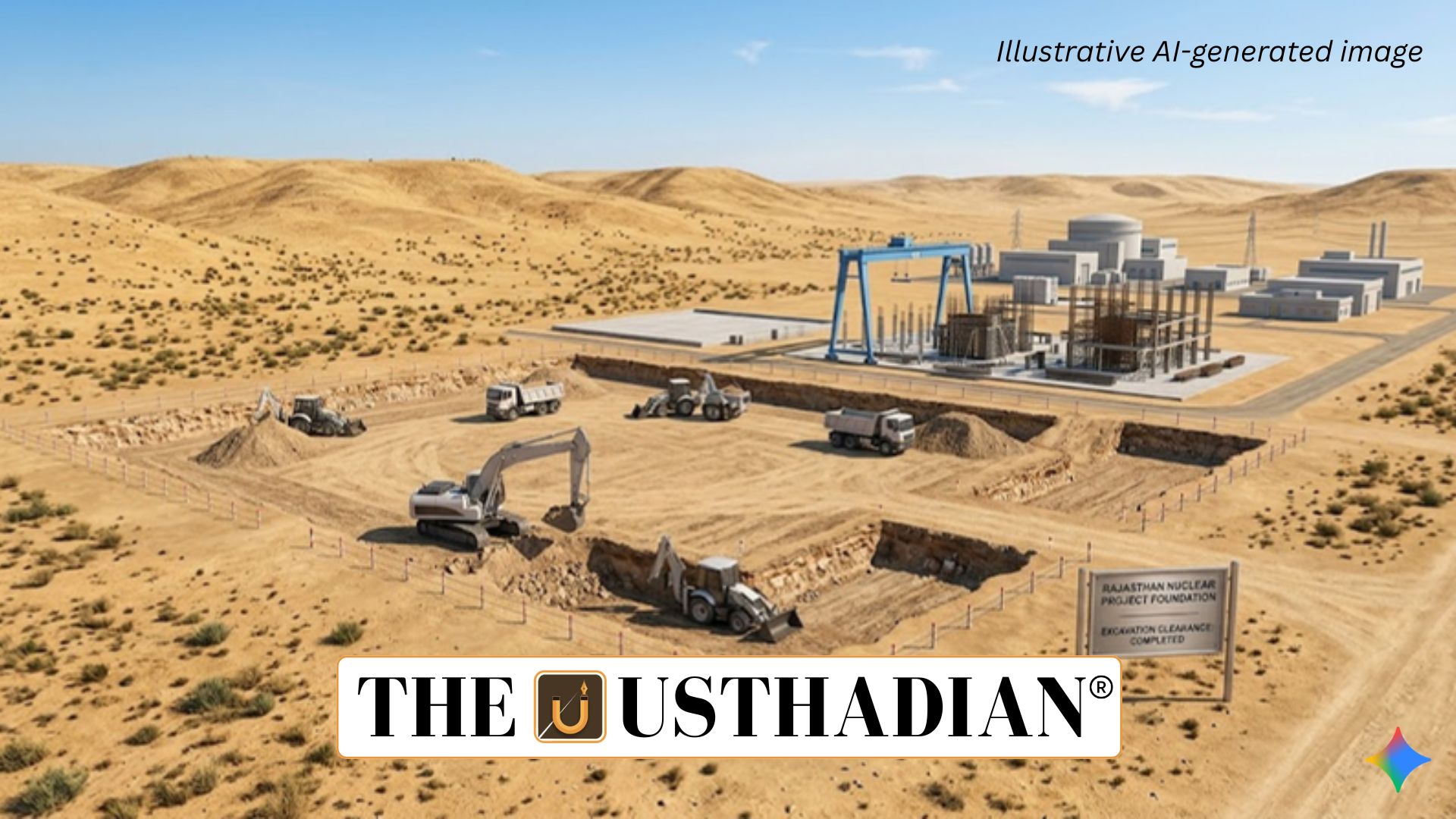
Approval for excavation work
AERB Clears Excavation for Rajasthan Nuclear Project: The Atomic Energy Regulatory Board (AERB) has granted approval for excavation at the Mahi Banswara Rajasthan Atomic Nuclear Power Project (MBRAPP). This clearance is specifically for Units 1 and 2, marking the initial phase of construction.
The approval ensures that safety and regulatory standards are met before full-scale development begins. It represents a key milestone in expanding India’s nuclear energy infrastructure.
Static GK fact: AERB is India’s nuclear safety regulator established in 1983 to oversee radiation and nuclear safety.
Project location and features
The project is located in Banswara district of Rajasthan, near the Mahi Dam on the Mahi River. This strategic location supports water availability, which is crucial for nuclear reactors.
MBRAPP will have 4 units of 700 MWe each, based on Pressurized Heavy Water Reactor (PHWR) technology. These reactors use natural uranium as fuel and heavy water (D₂O) as both coolant and moderator.
Static GK Tip: India is one of the few countries using PHWR technology extensively, enabling energy production without enriched uranium.
Development and institutional framework
The project is being developed by Anushakti Vidhyut Nigam (ASHVINI), a joint venture between Nuclear Power Corporation of India Limited (NPCIL) and National Thermal Power Corporation (NTPC).
It is part of India’s “fleet mode” initiative, where multiple reactors of the same design are built simultaneously. This approach reduces costs, improves efficiency, and ensures faster project completion.
Nuclear energy expansion strategy
India is actively boosting its nuclear energy capacity to meet future energy demands. The Nuclear Energy Mission, announced in the Union Budget 2025–26, focuses on developing Small Modular Reactors (SMRs).
The government aims to operationalize at least five indigenous SMRs by 2033. These reactors are smaller, safer, and more flexible compared to traditional nuclear plants.
Static GK fact: SMRs are advanced reactors with a capacity typically below 300 MW, designed for modular deployment.
Capacity and targets
As of March 2026, India operates 24 nuclear reactors across 7 power plants, with a total installed capacity of 8,780 MW.
The government plans to expand this capacity to 22,480 MW by 2031–32. In the long term, India has set a target of achieving 100 GW nuclear power capacity by 2047.
Nuclear power currently contributes around 3.1% of India’s total electricity generation, making it the fifth-largest non-fossil fuel source.
Legal and policy support
To strengthen the sector, the government introduced the SHANTI Act, 2025, aimed at modernizing India’s nuclear regulatory framework. This act simplifies procedures and enhances safety compliance.
Policy reforms, along with increased investments, are expected to accelerate nuclear power development in India.
Way forward
The excavation approval for MBRAPP reflects India’s commitment to clean and reliable energy. Nuclear power plays a crucial role in reducing carbon emissions and ensuring energy security.
With strong policy backing, technological advancements, and global collaboration, India is set to significantly expand its nuclear energy footprint in the coming decades.
Static Usthadian Current Affairs Table
AERB Clears Excavation for Rajasthan Nuclear Project:
| Topic | Detail |
| Approval Authority | Atomic Energy Regulatory Board |
| Project Name | Mahi Banswara Rajasthan Atomic Nuclear Power Project |
| Location | Banswara, Rajasthan near Mahi River |
| Reactor Type | Pressurized Heavy Water Reactor |
| Total Capacity | 4 x 700 MWe |
| Developer | ASHVINI (NPCIL + NTPC joint venture) |
| Current Capacity | 8,780 MW (March 2026) |
| Future Target | 100 GW by 2047 |